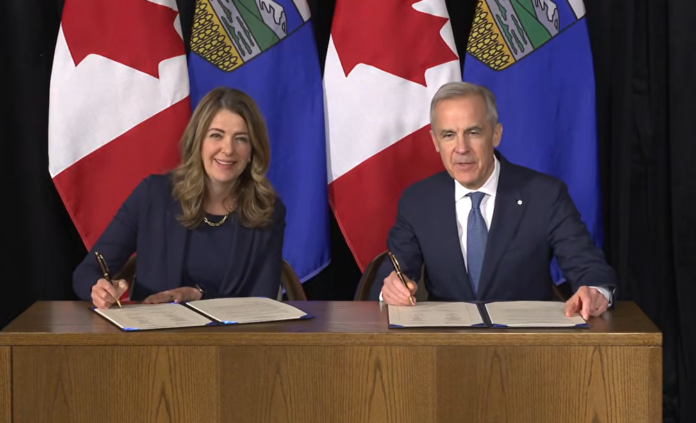

A sweeping agreement between the federal government and Alberta would pave the way for the potential start of construction on a new oil pipeline to British Columbia’s west coast as early as 2027.
It also lays out commitments related to Alberta’s carbon pricing system, clean energy regulations and the Pathways carbon storage project.
The agreement builds on a memorandum of understanding (MOU) signed between Ottawa and Alberta last November.
Alberta had already committed to submitting an application for a pipeline to the federal Major Projects Office by July 1.
The federal government said it will aim to reach a decision by Oct. 1 on designating the pipeline as a project of national interest for fast-tracked approval.
It said that if conditions are met, including consultation obligations with First Nations, Ottawa could approve construction on a pipeline by Sept. 1, 2027.
There is currently no private sector proponent or route for a new pipeline that would carry Alberta bitumen to the west coast for export to Asian markets.
Premier Danielle Smith said the agreement signals Alberta and Canada are committed to expanding market access and building major infrastructure projects.
“This agreement sends a clear message to investors and global partners that Canada and Alberta are serious about expanding market access, building major infrastructure and creating the conditions for long-term investment in our province’s energy sector,” Smith said.
Prime Minister Mark Carney called it “a great day” for Alberta and Canada.
He said there would be “open dialogue” with British Columbia and First Nations as the federal government and Alberta move forward with their commitments.
Carney and Premier David Eby are set to meet in Vancouver next week for discussions.

In a statement Friday, Eby slammed the agreement as “rewarding bad behaviour.”
“It cannot be the case that the projects that get prioritized in Canada are those where a Premier threatens to leave the country,” said Eby, referring to criticism that Premier Danielle Smith hasn’t done enough to quash separatism in Alberta.
Eby reiterated his concerns that B.C.’s shovel-ready projects aren’t getting enough attention, while Ottawa focuses on a pipeline proposal from Alberta that does not have a proponent or a route.
Alberta favours a northern route for a new pipeline, despite a long-standing moratorium on oil tankers in the waters off B.C.’s north coast.
“Our government’s opposition to any repeal of the North Coast tanker ban has not changed,” said Eby.
The B.C. Conservatives said the NDP government’s opposition to the pipeline has left the province sidelined in discussions.
“This is a nation-building deal, and the BC NDP have been locked out of the room,” said interim leader Trevor Halford. “Make no mistake, this is a deal about BC’s coast, BC’s ports, BC’s workers, and BC’s future. And the NDP weren’t even invited.”

The agreement also outlines a revised industrial carbon pricing framework.
Alberta’s effective industrial carbon price would increase to $130 per tonne by 2040.
The headline price on carbon would increase from the current $95 per tonne to $100 next year, and remain at that price through 2029. It would then increase each year to reach $140 per tonne by 2040.
That would be lower than the federal benchmark for the carbon price that applies to all provinces and territories. That price was set to rise to $170 per tonne by 2030. but the agreement said Canada will update that benchmark to be consistent with its agreement with Alberta.
Ross Linden-Fraser, research lead at the Canadian Climate Institute, said the agreement threatens to undermine Canada’s emissions reductions targets and weaken climate policies in other provinces.
“Our research shows that Canada’s industrial carbon pricing systems can deliver really significant emission reductions, but to deliver those reductions, the systems would need to be more robust than the ones laid out in this agreement and the price of traded credits would need to climb faster,” said Linden-Fraser.
“We don’t think this agreement is going to put Canada in a position to achieve its stated goals of achieving net-zero by 2050,” he said.
He said a new carbon pricing scheme could also jeopardize billions in investment in low-carbon projects that are tied to the strength of the industrial carbon pricing systems.
“This is going to mean that provinces like B.C. will have to change their own system, and that will probably mean attracting less investment into the region,” he said.
The deal also includes commitments not to proceed with a federal oil and gas emissions cap, to suspend implementation of the federal Clean Electricity Regulations in Alberta and to streamline environmental review processes through a new impact assessment agreement.
Officials also said they will establish a joint electricity working group to examine low-emission technologies including nuclear, geothermal, hydrogen, wind, solar and natural gas with carbon capture.
-With files from Vista Radio News