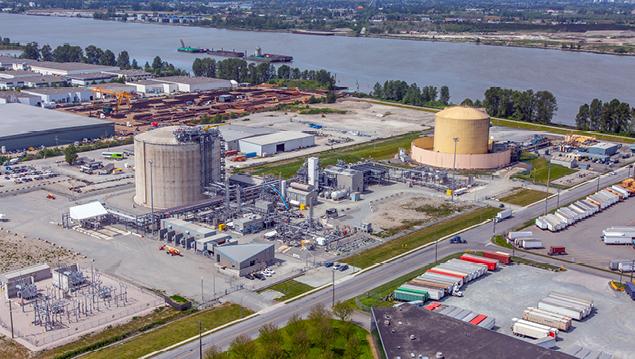

The British Columbia government has cleared a regulatory hurdle for FortisBC’s proposed Phase 1B expansion of its Tilbury liquefied natural gas (LNG) facility in Delta, saying the project will support jobs, economic growth and the province’s marine-fuelling sector.
The province has issued an order in council exempting the project from obtaining a certificate of public convenience and necessity under the Utilities Commission Act. The government said the exemption provides greater regulatory certainty for the more than $2-billion project while protecting FortisBC ratepayers from bearing the cost of the investment.
Energy and Climate Solutions Minister Adrian Dix said the expansion would create jobs, stimulate investment and provide an opportunity for Musqueam Indian Band to become an equity partner.
“The expansion of the Tilbury LNG Facility is an investment in B.C.’s future, creating jobs, growing our economy and helping reduce emissions through an investment of more than $2 billion,” Dix said. “By helping move this project forward, we’re also creating an opportunity for Musqueam Indian Band to become an equity partner, advancing economic reconciliation while supporting a cleaner alternative to traditional marine fuels like diesel.”
The province said the regulatory changes establish a framework allowing Musqueam Indian Band to acquire an ownership interest in the project through a partnership with FortisBC.
According to the government, the expansion will increase LNG production capacity to meet growing demand for marine fuelling at the Port of Vancouver and improve access for vessels operating along the west coast of North America and across the Pacific.
Jobs and Economic Growth Minister Ravi Kahlon said the project aligns with the province’s strategy to attract major private-sector investment.
“With global uncertainty raising costs for people and businesses, it’s never been more important to take real action on projects that strengthen B.C.’s economic future,” Kahlon said. “This project helps position B.C. as a leading LNG marine fuelling hub, reducing diesel fuel use and displacing higher-emission marine fuels for the international marine industry.”
The province estimates the project will generate more than $800 million in gross domestic product during construction, support an average of about 1,100 jobs annually over four years, produce $260 million in tax revenue and generate between $15 million and $20 million a year in natural gas royalties.
FortisBC president and CEO Roger Dall’Antonia welcomed the government’s decision.
“We commend the Province for their leadership in approving these amendments, which will allow us to further decarbonize marine shipping in the Port of Vancouver,” Dall’Antonia said. “We are proud to partner with the Musqueam Indian Band on this project that will benefit the region for decades to come.”
Musqueam Chief Wayne Sparrow said the proposed partnership represents an opportunity for First Nations ownership in major infrastructure projects.
“This project reflects the importance of First Nations being owners, not just participants, in major developments on our territories,” Sparrow said.
The project remains subject to additional regulatory approvals and permits before construction can begin. If approved, construction could begin as early as mid-2027, with the expanded facility expected to enter service in 2031.