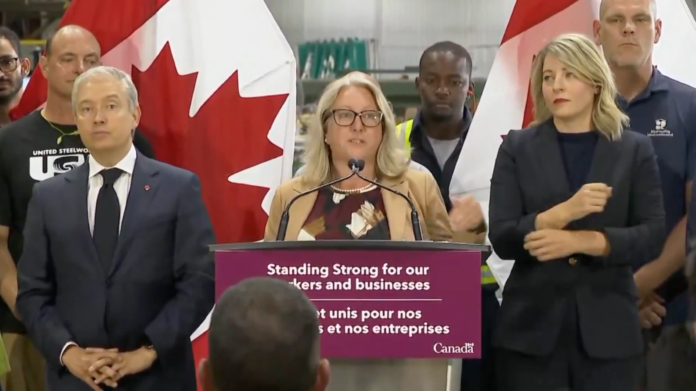

The federal government announced tariffs on $27.6 billion in U.S. goods and a $7.5-billion support package Tuesday in Ottawa to help Canadian businesses and workers withstand the escalating trade war.
Finance Minister François-Philippe Champagne announced the counter-tariffs at Ideal Roofing, while Industry Minister Mélanie Joly and Jobs and Families Minister Patty Hajdu outlined assistance for businesses and workers.
“Today, I’m announcing that Canada will match the United States tariffs dollar for dollar, rate for rate,” Champagne said.
Canadian counter-tariffs scheduled for Sept. 8
The Canadian counter-tariffs are scheduled to take effect at 12:01 a.m. on Sept. 8, according to the Department of Finance.
The federal government’s tariff list shows existing 25 per cent tariffs on some U.S. steel and aluminum products will increase to 50 per cent. Some American furniture and clothing will also face 50 per cent tariffs.
Appliances, cheese, fish and other seafood and certain steel and aluminum derivative products will face 25 per cent duties. Other dairy products, including some milk and cream, will face 50 per cent tariffs.
Existing Canadian tariffs on U.S. automobiles will stay in place, Champagne said.
The finance minister said the measures respond to the American government’s decision to impose 50 per cent tariffs on $27.6 billion in Canadian goods on Aug. 22.
“It’s all about fairness. It’s all about level playing field. It’s all about supporting Canadian workers and Canadian businesses,” Champagne said.
Trump attacks Canada as Poilievre questions costs
U.S. President Donald Trump attacked Canada in a series of posts Tuesday morning, accusing the country of treating the United States unfairly.
“Canada is easily the most difficult and unreasonable,” Trump wrote on Truth Social. “They feel entitled, but they are not a State, and will be entitled no longer!”
The White House has identified disputes involving Canadian dairy, automobile and alcohol policies. However, a Global Affairs Canada briefing based on U.S. government data says the United States recorded a $34.3-billion U.S. merchandise trade surplus with Canada in 2024 when energy imports were excluded.
In an earlier post, Trump suggested changing the name of Lake Ontario.
“The United States is giving serious consideration to changing the name of Lake Ontario to Lake America,” he wrote.
The U.S. Board on Geographic Names governs naming conventions used by American federal agencies, but a U.S. name change would not compel Canada to rename the shared lake.
Trump also denied interfering with Canadians speaking French and described Prime Minister Mark Carney as “weak and ineffective.”
“I would never interfere with Canadians speaking French!” Trump wrote.
However, the U.S. trade representative’s 2026 report on foreign trade barriers identifies Quebec requirements promoting French-language content on streaming services as a concern for American companies.
Carney said Saturday that American negotiators sought concessions involving protections for French and Canadian culture.
“We were not prepared to compromise on the protection of the French language and our culture,” Carney said in remarks published by the Prime Minister’s Office.
Speaking at a news conference in Windsor before the federal announcement, Conservative Leader Pierre Poilievre questioned whether Canadian counter-tariffs would increase grocery bills, gasoline prices and the cost of other goods.
The federal tariff list does not identify gasoline as a targeted product.
Poilievre also renewed his call for Parliament to reconvene and for the government to release details of the rejected U.S. trade proposal.
Federal government expands support for businesses
In Ottawa, Joly said Canada must strengthen domestic manufacturing and reduce its reliance on the United States.
“Building at home is not a plan B; it is plan A,” Joly said.
“We cannot wait for Washington to decide the future. We’re strengthening our economy and building a more sovereign Canada.”
The federal support package includes $1.5 billion for regional development agencies to assist small and medium-sized businesses affected by the tariffs.
The maximum non-repayable contribution available through those agencies will increase from $1 million to $3 million, according to the Department of Finance.
Eligible businesses can receive up to $2 million in liquidity support. Whether that amount falls within the $3-million contribution ceiling was to be confirmed.
A new $500-million funding stream through the Business Development Bank of Canada’s Pivot to Grow program will offer loans of $250,000 to $5 million to businesses facing tariff-related cash-flow problems, according to the federal backgrounder.
Joly described the loans as interest-free during the news conference, but the Department of Finance and the Business Development Bank of Canada say borrowers can make interest-only payments for up to 36 months.
The government will also provide $2 billion through a new Canada Strong Diversification Fund for companies undertaking capital projects or adapting to trade disruptions, according to the Department of Finance.
Joly urged Canadians to buy domestic products to help protect jobs.
“When you choose a Canadian product, you’re not only putting pressure on the U.S. Right now, you’re protecting jobs,” she said.
Worker supports include expanded EI and training
Hajdu said the government will provide $3.5 billion over four years to support workers and employers affected by the trade dispute.
The government will extend measures waiving the one-week Employment Insurance waiting period and allowing workers to receive benefits without first exhausting severance or vacation pay, she said.
The Department of Finance said both measures will be extended for one year.
A temporary measure providing eligible long-tenured workers with up to 20 additional weeks of regular Employment Insurance benefits will be extended for eight months, according to the federal backgrounder.
Under a new worker retention and retraining program, employers will be able to reduce employees’ schedules to as little as two days a week while workers receive Employment Insurance to replace part of their lost income, Hajdu said.
When employees receive training, their income replacement can increase from 55 per cent to about 70 per cent, according to the existing federal Worker Retention Grant program.
The new program will also provide up to $1,000 per participant to help cover training and administrative costs, according to the federal backgrounder.
“The best news for workers is when they stay in their workplace, even during slower times,” Hajdu said. “It’s good news for their employers.”