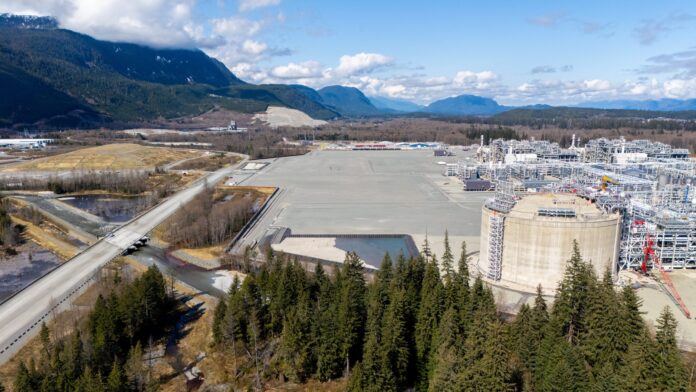

LNG Canada is going ahead with its Phase 2 expansion project in Kitimat, British Columbia, a project that is expected to double the facility’s exports of liquefied natural gas.
The company said Tuesday its joint venture participants — Shell, PETRONAS, PetroChina, Mitsubishi Corporation and Korea Gas Corporation — have made a final investment decision on the multibillion-dollar project.
LNG Canada president and CEO Chris Cooper said the expansion would put the facility on track to become one of the largest LNG facilities in the world.
“LNG Canada Phase 2 is another nation-building investment that demonstrates Canada can build big things when governments, First Nations partners, local communities, skilled trades, contractors and investors work together with shared purpose,” said Cooper.
Phase 2 was referred by Prime Minister Mark Carney to the federal Major Projects Office for potential fast-tracking.
Carney was in Vancouver Tuesday to highlight the investment decision as part of efforts to diversify Canadian exports away from the U.S.
“It will create thousands of new jobs. It will connect low cost, low carbon Canadian energy to global markets. It will provide secure supply our partners in Asia and Europe need,” said Carney.
He said construction would begin immediately.

LNG Canada’s Phase 1 is Canada’s first large-scale LNG export facility and completed its first shipments to Asian markets in June 2025.
The Phase 2 expansion will add two additional LNG processing units within the existing facility and other infrastructure. It is expected to increase production from 14 to 28 million tonnes per year.
LNG Canada said it is also working with Coastal GasLink to expand the capacity of the existing pipeline.
The cost of the expansion project has been estimated at $33 billion.
Five neighbouring First Nations have partnered on a $1 billion equity option agreement, including the Gitga’at, Gitxaała, Haisla, Kitselas and Kitsumkalum First Nations.
The agreement would allow the First Nations to purchase an LNG storage tank to be built as part of Phase 2, and lease it back to LNG Canada for the life of the project.
LNG Canada calls it one of the largest Indigenous ownership positions in major Canadian infrastructure.
Haisla Nation elected Chief Councillor Maureen Nyce welcomed the final investment decision.
“For our people, it represents what is possible when industry and Indigenous communities come together as true partners, creating generational prosperity for our people, our neighbouring nations and for Canada as a whole,” said Nyce.

The B.C. NDP’s election campaign claimed the announcement as a win for party leader David Eby.
Phase 2 is on the B.C. government’s list of priority projects, and support for the project was included in a co-operation agreement reached between B.C. and Ottawa earlier this year.
“This is a very big deal, indeed,” Eby said in Vancouver.
He thanked Carney for supporting the project, as well as others who helped get Phase 2 to a final investment decision.
The B.C. Conservatives also welcomed the investment.
“British Columbia needs many more announcements like today’s final investment decision on LNG Canada Phase 2, not just one expansion after too many years,” said Claire Rattée, B.C. Conservative candidate for Skeena.
Interim Leader Lorne Doerkson released details of the party’s proposed energy strategy on Monday. He said a B.C. Conservative government would seek to triple LNG production by 2035.
The NDP’s Ravi Parmar criticized the plan, saying that B.C. is already on track to surpass that goal with five projects that are either under construction, permitted or awaiting final investment decision.

Eby emphasized claims that the LNG produced at the Kitimat facility will be “cleaner” compared with facilities in the U.S. and other countries.
He said LNG Canada’s carbon emissions are expected to be 30 per cent lower than the world’s best-performing facilities, and 60 per cent lower than the global average.
Environmentalists have accused LNG companies and governments of “greenwashing” the industry, and say ramping up fossil fuel production and increasing shipping emissions will set Canada back in its climate goals.
LNG is produced by chilling natural gas to a temperature of about minus 160 degrees Celsius, converting it to a liquid state.
Natural gas is a fossil fuel composed mostly of methane, and is extracted by drilling down into gas reserves deep underground.
The process sometimes involves hydraulic fracturing, or “fracking,” to create pathways in the rock, which uses significant amounts of water and can cause increased earthquakes.
Concerns have been raised about emissions produced by increased flaring at LNG Canada’s Kitimat facility and the potential health impacts on surrounding communities.
Critics also say the global LNG market is due to become increasingly oversaturated and volatile in the coming years.
An independent review of British Columbia’s CleanBC climate action plan released last fall said increased gas production and new LNG export projects add significant new sources of climate pollution and threaten to wipe out progress made in other sectors.
B.C. Green Leader Emily Lowan said Tuesday she was “deeply disappointed” by the decision to move ahead with LNG Canada Phase 2.
“LNG Canada is an entirely foreign-owned project. It is owned by Shell, one of the most profitable companies in history, several foreign state-owned oil companies, and US private equity,” said Lowan. “The profits from LNG development flow directly to shareholders and governments abroad, while the costs stay here.”