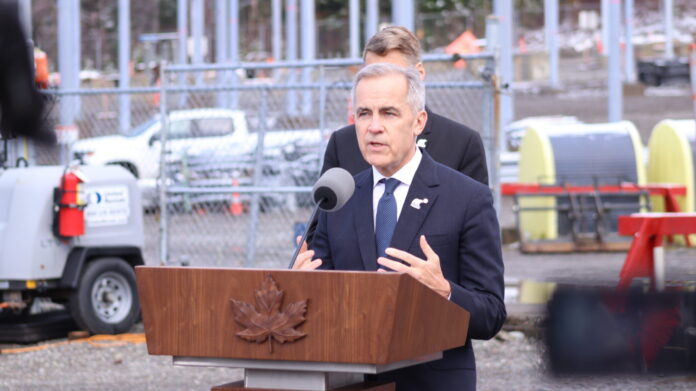

Prime Minister Mark Carney said a proposed new pipeline from Alberta’s oilsands to British Columbia’s coast has been designated a project of national interest, granting it a streamlined federal permitting process.
The official name of the project, previously referred to as the West Coast Oil Pipeline, will be Pacific Link.
Speaking in Fort McMurray, Alta., on Thursday, Carney said the designation as a project of national interest means the federal Major Projects Office and the Canadian Energy Regulator will lead the review process and stakeholder consultations for the project over the next year.
The process is expected to consider ownership, benefits, Indigenous rights, environmental protections, local hiring and oversight.
He said the MPO would work to finalize those conditions by Sept. 1, 2027, and construction could begin soon after.
“This means that as the project proponents work over the next year to develop their final concept … they can do so with confidence that the federal government supports this project,” said Carney.
The federal and Alberta governments announced details of the pipeline proposal in July.
The pipeline would follow a southern route to the B.C. coast, maintaining the federal oil tanker moratorium on the province’s North Coast.
Carney said the designation as a project of national interest comes after three months of consultation with Indigenous communities along the potential pipeline routes.
Canada and Alberta would share equal ownership of the project, and Indigenous communities would be offered at least 10 per cent ownership interest.
The project would be led by Trans Mountain, while Pembina would act as a private-sector investor and contribute its expertise to the development.
Carney sidestepped a question about how many federal taxpayer dollars would go into getting the pipeline built.
“The Canadian taxpayer is going to make a lot of money off this pipeline,” he said.

The federal government said Pacific Link is expected to export an additional one million barrels a day to markets in Asia, generating more than $20 billion in GDP per year and $100 billion in government revenue by 2060.
Carney said the project is part of efforts to diversify Canada’s economy away from the U.S. and become a “global energy superpower.”
The B.C. Conservatives and CentreBC election campaigns welcomed the move.
B.C. Conservative interim leader Lorne Doerkson said his party would treat energy development as an “urgent mission.” The Conservatives released their proposed energy plan earlier this week, including plans to triple liquefied natural gas production by 2035.
CentreBC leader Elenore Sturko said the party would commit an additional $60 million for skilled-trades training if elected.
B.C. Greens leader Emily Lowan slammed the pipeline project, saying it would actually make Canada more vulnerable to U.S. influence.
“The pipeline’s oil tankers will travel through American waters close to B.C.’s coast, requiring cooperation with Trump’s government,” said Lowan in a statement. “Trump, already proven to be an unstable negotiator, could deny access to the United States’ waters from Canadian tankers.”
Lowan said the increased movement of large oil tankers puts the coast and coastal economies at risk.
Premier David Eby initially voiced opposition to Alberta’s push for a new pipeline through B.C., and to any tax dollars going toward the project. He said a northern route was a non-starter for coastal First Nations, and that the pipeline was a threat to existing major projects in B.C.
B.C. was left out of Alberta’s negotiations with Ottawa around a memorandum of understanding on the potential project that was announced last November.
Eby struck a multibillion-dollar deal with Carney in July, just before Alberta Premier Danielle Smith released details of her proposal to the MPO.
The Canada-British Columbia Cooperative Prosperity Agreement promises to preserve the oil tanker moratorium and ensure B.C. would see economic benefits if Alberta’s proposed pipeline project goes forward.
The deal acknowledges that, while B.C. does not seek a new pipeline, the province would participate in good faith in necessary routing and permitting discussions, as long as Ottawa follows through on its commitments to maintain the tanker ban and engage meaningfully with First Nations.
Canada and B.C. would also negotiate a framework for the province to get a share in the profits from the project. That could include an annual royalty payment to B.C. by the pipeline operator, and federal funding for the province and First Nations to respond to environmental risks.