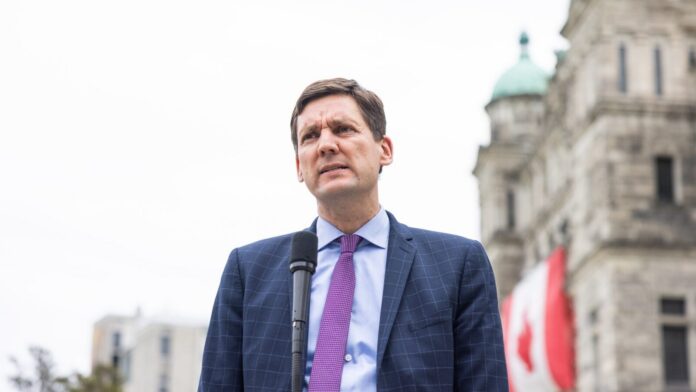

B.C. Premier David Eby said the additional 50-per-cent tariffs imposed on Canadian goods by the United States are “inexplicable” and “indefensible” and reaffirmed his refusal to return American alcohol to government liquor store shelves.
“Every possible tool, every weapon that can be deployed by the federal government in this economic war that is being waged on Canada is on the table for British Columbia,” said Eby.
He said B.C. was identifying ways to support the federal response to the tariffs, which took effect at 9:01 p.m. Pacific time Friday, Aug. 21, or 12:01 a.m. Eastern time Saturday, Aug. 22, on an estimated $28 billion in Canadian goods.
Prime Minister Mark Carney suspended trade negotiations with the U.S. on Friday, saying last-minute changes to proposed American terms prevented an agreement.
Eby said Canadian negotiators were right to walk away from the deal.
“There is no question that there will be economic pain associated with this, there already is,” said Eby. “But it is necessary to stand up to a bully, and if you don’t, they’ll just keep coming back for more.”
U.S. demands ‘unacceptable’
He said several U.S. demands would have made the agreement unacceptable for Canada.
“The suggestion that Canada would not trade with other countries or reduce our trade with other countries because the Americans tell us to, would reduce us to the economic equivalent of the 51st state,” he said.
Eby said B.C. wanted progress on reducing tariffs affecting softwood lumber producers and manufacturers that use steel.
He said the U.S. should not expect to benefit from Canadian resources such as critical minerals while attacking the Canadian economy.
“From my perspective, in terms of Canada having what the world needs, we got lots of other dance partners out there,” said Eby.
Carney said Canada would match the new tariffs dollar for dollar beginning Tuesday, Sept. 8, and promised additional support for affected workers and businesses. He said the government had provided nearly $25 billion in support over the previous 18 months.
Eby said Carney told premiers the federal government was examining ways to streamline support for smaller businesses, which Eby said were likely to be among the hardest hit.
U.S. President Donald Trump initially set Aug. 19 as the implementation date for the tariffs before granting a three-day postponement to allow more time for negotiations.
Trump introduced the measures under Section 338 of the U.S. Tariff Act of 1930. The legislation allows the president to impose duties of up to 50 per cent in response to what the administration considers discriminatory treatment of American goods.
The tariffs cover a range of Canadian products, including plywood and other processed wood products.
Some goods exempt
However, goods already subject to separate U.S. tariffs under Section 232, including softwood lumber, are exempt from the additional Section 338 duties.
Global Affairs Canada figures put the combined anti-dumping and countervailing duty facing most Canadian softwood lumber exporters at about 35 per cent. A separate 10 per cent U.S. tariff on softwood lumber brings the total to approximately 45 per cent.
The White House has cited provincial restrictions on American alcohol sales, Canadian dairy import quotas and policies affecting U.S.-made vehicles as reasons for the new tariffs.
Several provinces, including B.C., restricted sales of American alcohol in 2025 after Trump imposed tariffs on Canadian goods.
B.C. removed American beer, wine and spirits from government liquor store shelves and directed the BC Liquor Distribution Branch to stop purchasing those products.
The restrictions became a point of contention in Canada-U.S. trade negotiations.
Several premiers, including Nova Scotia’s Tim Houston and Manitoba’s Wab Kinew, confirmed that Carney asked provinces on Wednesday, Aug. 19, to prepare to return American alcohol to store shelves if negotiators reached a trade agreement.
Eby said the idea of stocking U.S. alcohol under the current trade conditions was “absurd.”
“As long as this economic attack continues on our softwood sector, as long as it continues on our economy here in British Columbia, the booze will not be going back on the shelves,” he said.