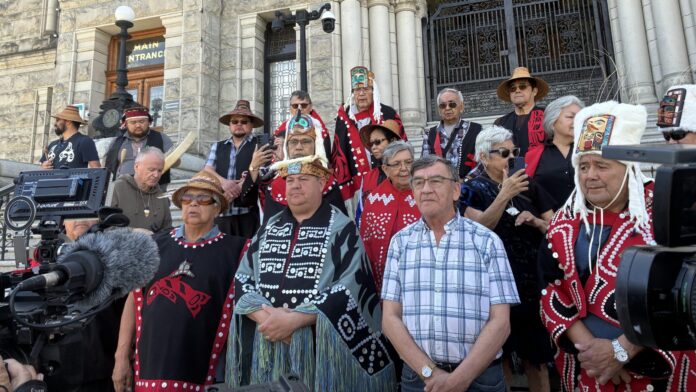

Eleven former British Columbia attorneys general have signed a letter supporting modern treaties, amid debate over Indigenous land claims and private property rights.
“Modern treaties provide a negotiated framework for recognizing Indigenous rights while preserving the security of private property. They do not displace ordinary homeowners or businesses from their fee-simple lands,” said the letter.
“Modern treaties offer the clearest and most durable means of advancing reconciliation while maintaining confidence in private property rights,” it said. “This is not a choice between reconciliation and economic opportunity. Modern treaties help make both possible.”
The signatories include attorneys general from a range of political backgrounds, including former NDP premier and attorney general Ujjal Dosanjh and other NDP attorneys general Andrew Petter, Colin Gabelmann, Graeme Bowbrick and Murray Rankin.
Former Social Credit attorney general Brian Smith also signed the letter, along with former B.C. Liberal attorneys general Geoff Plant, Wally Oppal, Mike de Jong, Shirley Bond and Suzanne Anton.
B.C.’s NDP government tabled a pair of treaty bills earlier this year that have each been more than three decades in the making, but proved to be controversial.
Neighbouring First Nations and the Union of B.C. Indian Chiefs called on the province to pause the implementation bills for the treaties with the K’omoks and Kitselas First Nations, saying overlapping land claims had not been adequately addressed.
The B.C. Conservatives and others have also raised concerns about the modern treaty process, including the inclusion of the United Nations Declaration on the Rights of Indigenous Peoples (UNDRIP) as an interpretive framework.
The K’omoks Treaty Act was passed and received royal assent on May 28, but a vote on the Kitselas Treaty Act was put off until the fall legislative session.
Another treaty currently being negotiated with five Vancouver Island First Nations has also raised concerns about future public access to Hatley Castle in Colwood, a national historic site that also serves as a campus for Royal Roads University.