
First Nations leaders gathered in Ottawa Wednesday to call on the federal government to treat residential school denialism as hate speech.
Leaders from across Canada unanimously passed an emergency resolution Tuesday as part of the Assembly of First Nations general assembly in Ottawa.
The resolution said First Nations remain concerned that residential school denialism is not adequately addressed in federal law, and calls on Canada’s government to introduce stand-alone legislation to criminalize it as hate speech.
“First Nations across Canada continue to face pervasive and systemic racism, including a deeply disturbing rise in IRS denialism, where the public condoning, denying, or minimizing of the IRS system and the tragic reality of unmarked graves perpetuates harm, retraumatization, and discrimination, and constitutes hate speech against First Nations and Survivors,” it said.
The resolution also said there remains a lack of clear protections for First Nations sacred and burial sites.
B.C. Assembly of First Nations Regional Chief Terry Teegee said there has been an “exponential” rise in anti-Indigenous hate in B.C. and across the country in recent years, from both the public and elected officials.
“The denialism is not an academic debate. It’s hate speech and it is fact,” said Teegee. “It retraumatizes survivors, harms entire communities, disrespects children who never made it home, denies historical facts and undermines truth and reconciliation. If left unaddressed this gap risks enabling harmful narratives that perpetuate racism, misinformation and historical erasure of our history.”

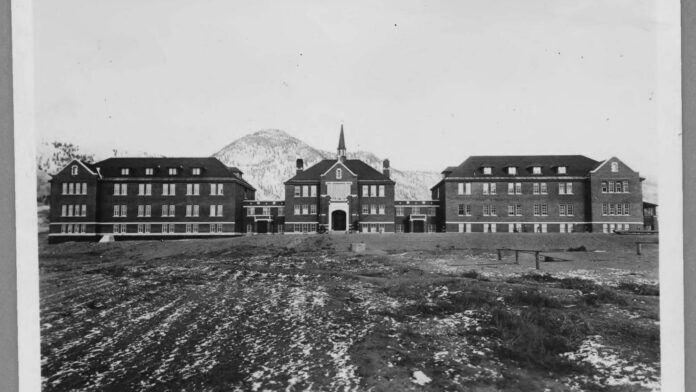
He pointed to the experiences reported by Tk̓emlúps Te Secwépemc members after the 2021 announcement of potential unmarked burial grave sites at the former Kamloops Indian Residential School.
Chief Rosanne Casimir testified before a Senate committee in March that the band office had received a large number of hateful phone calls, including threats of violence, in relation to the announcement.
Denialists have also allegedly entered the site without permission to attempt to locate and dig up remains, according to a 2023 report by the independent special interlocutor for missing children and unmarked graves and burial sites associated with Indian Residential Schools.
Casimir said Wednesday that a technical team of experts continue to advance work at the Kamloops site with the support of the federal government, and conversations were ongoing with neighbouring First Nations on moving forward in a culturally sensitive way.
The Truth and Reconciliation Commission of Canada has said the residential school system amounted to “cultural genocide,” where thousands of children were forcibly taken from their families, subjected to abuse, and many never returned home.
The federal Bill C-9, or Combatting Hate Act, received royal assent on June 18. Part of the bill aims to more clearly define what constitutes a hate crime, and makes it a crime to promote hatred against an identifiable group by displaying certain terrorism or hate symbols in public.
The legislation does not include a proposed amendment that would have made residential school denialism an offence. The amendment was initially proposed by Nunavut Sen. Nancy Karetak-Lindell. It passed the Senate human rights committee but was ultimately rejected by the Senate in a 32-41 vote.
“Bill C-9 was an opportunity to rectify this issue,” said Teegee.
“My message is simple: C-9 must align with the United Nations Declaration on the Rights of Indigenous Peoples, and be strengthened to reduce unintentional harms and fully protect First Nations truths and sacred spaces and places,” he said.