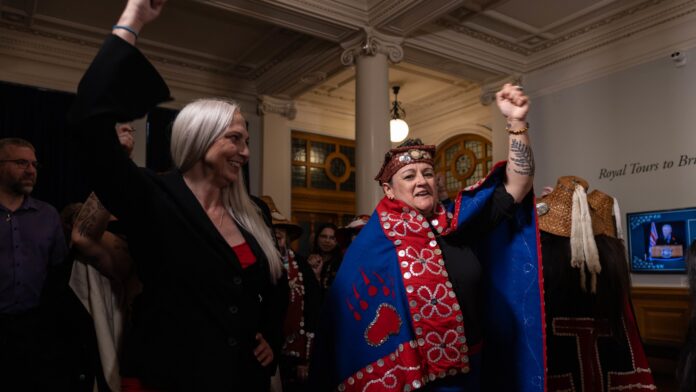

The K’ómoks and Kitselas First Nations said their treaty bills have been “mischaracterized” as they push back against calls to halt the ratification process in the legislature.
The British Columbia government tabled separate treaty implementation bills with the two nations earlier this month. It was the first step in a lengthy ratification process before the treaties can take effect.
Negotiations for both treaties began more than 30 years ago.
But neighbouring First Nations are calling for a 180-day pause to the ratification process, saying their concerns about overlapping land claims have not been adequately addressed.
The Nine Allied Tribes and the Lax Kw’alaams Band have said the Kitselas Treaty would affect about 90 per cent of their traditional territory, located in northwestern B.C. near Prince Rupert.
The Wei Wai Kum First Nation, near Campbell River, said the K’ómoks Treaty would impact 80 per cent of its territory.
Representatives from the Union of B.C. Indian Chiefs (UBCIC) joined the Nine Allied Tribes, the Lax Kw’alaams, and the Wei Wai Kum First Nations for a press conference in Victoria on Tuesday to call for the bills to be halted.
UBCIC vice-president Linda Innes said B.C.’s decision to move forward without the consent of all impacted nations is “destructive and divisive.” She said there is likely to be protests and legal challenges if the treaty legislation proceeds.
The Haisla Nation, near Kitimat, this week joined calls for the Kitselas treaty process to be paused.
“Haisla Nation supports the right of all First Nations, including Kitselas, to pursue treaties and self-determination,” it said in a statement. “However, those outcomes must not come at the expense of other Nations or through processes that leave key issues unresolved.”

Some other neighbouring First Nations have signed or are working on protocol agreements regarding shared territories with the K’ómoks and Kitselas.
Stan Dennis Jr., hereditary leader of the Nine Allied Tribes, said they were once involved with the treaty process with the Kitselas and the B.C. government, but withdrew due after coming to an impasse.
Wei Wai Kum Chief Chris Roberts said talks with the K’ómoks toward an agreement have been nearly at a standstill for several years.
“It just baffles me that it’s been allowed to proceed this far,” he said.
“We’re looking for a fair process to bring in Indigenous laws, our history and the connection that we have together as a people as part of the answer to how that can be reflected in a modern treaty agreement, so that there’s not the fears of what we might lose in the future,” said Roberts.
K’ómoks said in a statement Thursday there have been “several inaccuracies” in the concerns raised about their treaty bill.
That includes claims that the treaty references B.C.’s Declaration on the Rights of Indigenous Peoples Act (DRIPA), which has recently been the subject of intense political scrutiny in B.C.
It said the treaty does not include DRIPA, but references the U.N. Declaration on the Rights of Indigenous Peoples (UNDRIP) as part of a “broader interpretive framework” for the treaty.
“The Treaty does not require British Columbia laws to align with UNDRIP, nor does it require all laws to be interpreted through it,” the nation said in a statement.
K’ómoks Chief Councillor Nicole Rempel also disputed claims that the treaty would grant them 80 per cent of Wei Wai Kum First Nation’s territory.
“We recognize it as a shared territory, and the fact that the land base in our treaty package is 12,500-ish acres, leaving millions and millions of acres for them to negotiate in their own treaty — that’s not the narrative that’s put out there,” said Rempel.
She added that the K’ómoks and Wei Wai Kum have had two meetings since March to discuss protocols.
David Try, senior treaty negotiator for Kitselas, said the First Nation will continue to negotiate in good faith with its neighbours.
“We’re not going anywhere, neither are they,” he said. “We will work together to the best of our ability to establish protocols and answer any comments or concerns of First Nations, neighbours, or other stakeholders.”

It’s not guaranteed that the treaty bills will have the votes to pass in the legislature. The NDP has a one-seat majority in the House, but Vancouver-Strathcona MLA Joan Phillip has not been available to participate in proceedings in recent days due to a serious health issue.
It is not yet clear how the B.C. Conservatives or B.C. Greens plan to vote on the bills.
George Abbott, head of the B.C. Treaty Commission, said he’s optimistic the bills will be passed.
“I’m hoping that the political parties see a separation between treaty and the controversy around DRIPA,” said Abbott.
The province has said the negotiations will continue throughout the ratification process to address the territorial concerns.
B.C. Indigenous Relations Minister Spencer Chandra Herbert told reporters at the legislature on Thursday he believes they are “good treaties.”
“We’ve been working very hard with neighbouring nations on questions of overlap,” he said.
He declined to comment on next steps if the treaty bills don’t make it through the legislature, saying he doesn’t “deal in hypotheticals.”