
The national chief of the Assembly of First Nations called on the United Nations to condemn British Columbia’s push for changes to its landmark reconciliation law.
National Chief Cindy Woodhouse Nepinak addressed delegates at the U.N. Permanent Forum on Indigenous Issues in New York on Tuesday.
“As you know, the inherent pre-existing rights of First Nations are part of, and are protected by, international human rights law. They cannot be suspended, amended, or paused at the convenience of any government,” she said, according to a transcript provided to Vista News by the AFN. “We ask for your support and condemnation of British Columbia’s regressive decisions.”
Woodhouse Nepinak also criticized the B.C. government’s proposed suspension of the Declaration on the Rights of Indigenous Peoples Act (DRIPA) in a separate statement on Monday.
“Everything about this action is completely contrary to the spirit and letter of the Declaration and the province’s own legislation,” she said. “The Premier’s unilateral decision represents a huge step backwards for human rights and for reconciliation in Canada.”
The B.C. government said on Sunday it will not bring legislation to suspend DRIPA during this spring legislative session.
It was the latest back-pedal for Premier David Eby, who has spent months arguing that changes to the law are urgently needed to protect the province from legal risk. The concerns follow two 2025 court cases related to title rights and DRIPA.
Eby said in December his government was pursuing permanent amendments to DRIPA.
After intense opposition from First Nations, he said earlier this month the province would instead introduce legislation to temporarily suspend parts of the law.
Eby said he would stake his government on the bill by making the vote confidence motion in the House, but later walked that back too.
Eby said on Monday he had been prepared to table legislation this week to suspend parts of DRIPA, and expressed confidence he had the votes needed to pass it.
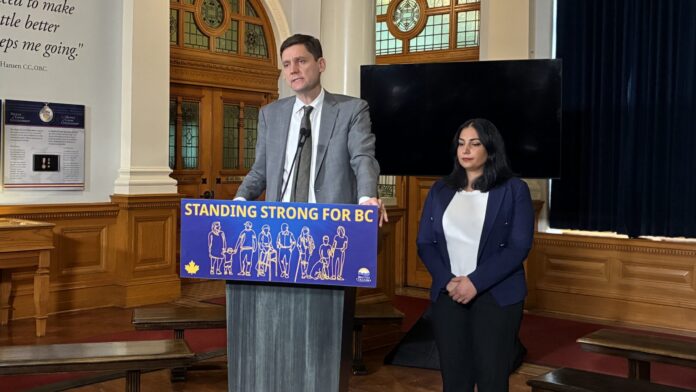
However, he credited B.C. Attorney General Niki Sharma with pitching to him an alternate route that will involve discussions over the coming months with First Nations in the hopes of finding some solution.
Asked about Woodhouse Nepinak’s comments on Tuesday, Sharma said these issues are “really complicated.”
“Our job as a government is to come to the table with our concerns and try to solve them,” said Sharma.
She did not rule out the possibility that legislative changes to the act could be introduced in the future, but expressed optimism a solution can be worked out with First Nations leaders.
“What I heard from leaders is a real desire to roll up our sleeves and sit down and find a solution to the liability risk that we very sincerely hold,” she said.
DRIPA was introduced in 2019, establishing the United Nations Declaration on the Rights of Indigenous Peoples as the p0rovince’s framework for reconciliation.