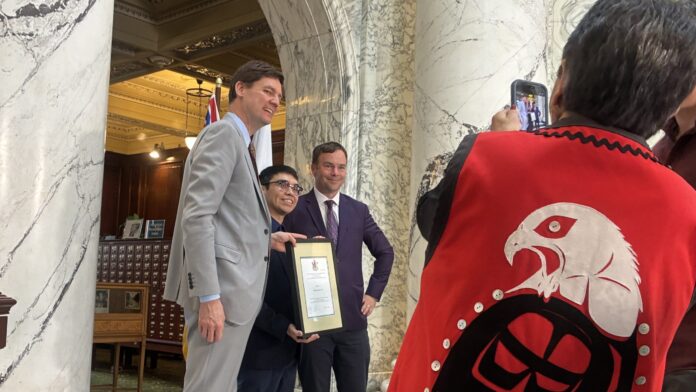

The British Columbia government has tabled a bill to implement a treaty with the Kitselas First Nation in west-central B.C. It comes amid pushback from neighbouring First Nations, who say the treaty would infringe on their territorial rights.
Once ratified, the treaty would affirm the Kitselas as owners of more than 380 square kilometres scattered near Terrace, including their current reserve lands. In total, the treaty lands would cover an area about three times the size of the City of Vancouver.
Cyril Bennett-Nabessz, Kitselas’ Director of Lands and Resources, said at an event at the legislature Wednesday the treaty represents generations of work.
“We have achieved [this treaty] not only as a community, but working together with British Columbia and Canada, something that our forefathers set out to do at the turn of the century, something that they wanted so much for our people,” said Bennett-Nabessz.
The introduction of the provincial bill marks a first step toward ratifying the treaty. Once the treaty is debated and passed in the House, it would still require several more steps before it can take effect.
Terrace Mayor Sean Bujtas has been involved in the negotiations and was in Victoria to see the bill be tabled.
“I’m really happy to support this community,” he said. “I think this is a good news story for the northwest as well and the Kitselas people.”
Negotiations for the Kitselas treaty began in 1993, and the treaty was initialled by all parties in June 2024, marking the end of substantive negotiations.
The treaty agreement would remove Kitselas from under the federal Indian Act and enable the First Nation to establish their own laws and governance. It would set out a process for shared decision-making with B.C. and Canada around forestry, energy, wildlife protection, and more.
Under the treaty, some recreation sites and parks would become treaty land, including parts of Kleanza Creek Provincial Park. The province says public access and recreational opportunities like hunting and fishing will not be affected in the majority of the treaty lands. The province would retain ownership of and access to public roads and highways.
Kitselas First Nation would receive funding from the province and the federal government. The provincial funding would include a one-time payment of $20 million for infrastructure and economic development, forestry fund payments totalling about $1.3 million and annual funding of $400,000 for lands and resource management.
Premier David Eby called the legislation an “historic milestone.” He said the treaty would bring more certainty and predictability to relations between the governments.
“When it becomes law at the provincial and federal level, it does not extinguish rights. It recognizes the Indigenous rights and title of Kitselas First Nation and it will lay out a negotiated approach to self-government for the Kitselas people,” said Eby.
The Lax Kw’alaams Band (LKB) and the region’s Nine Allied Tribes (NAT) said on Monday they were “blindsided” by a recent notice that the province planned to introduce the legislation related to the Kitselas treaty.
The First Nations said in a statement the treaty has “fundamental flaws that threaten reconciliation and legal certainty,” including that the proposed treaty legislation would extend Kitselas treaty lands and rights into their territories without their consent.
They said they were fully consulted on the treaty but the province failed to address their concerns. They called on the government to pause the legislation until the proposed treaty can be amended.
“The NAT and LKB will take every legal, peaceful, and public step and action necessary to defend and declare Aboriginal title over their territory, inherent rights, and inheritance belonging to their present and future Generations,” they said in a statement.
Indigenous Relations Minister Spencer Chandra Herbert pushed back Tuesday on the claim that neighbouring Nations were being “blindsided” by the treaty bill.
“It was publicly initialled over two years ago. There was a community vote over a year ago. So I don’t think there’s any way that we could be blindsided about this, because it was very public, and we’ll continue to be,” he told reporters.
The province said community and public engagement would continue, noting Canada and B.C. have a duty to consult neighbouring First Nations for the treaty to be fully ratified.
It is the second major treaty bill tabled this week. The province introduced a similar bill Tuesday related to a treaty with the K’ómoks First Nation.
Since 2000, four treaties have taken effect in B.C., covering eight First Nations.