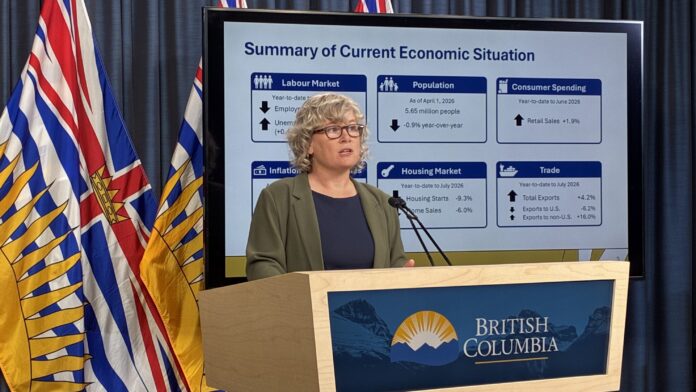

British Columbia’s latest fiscal update shows this year’s deficit is expected to be $450 million higher than initially forecast, as the province reports higher spending on wildfires and tax credits, along with lower-than-expected natural resource revenue.
Budget 2026 projected a deficit of $13.3 billion in February, but the Ministry of Finance said Monday it now expects a deficit of nearly $13.8 billion.
That’s despite a revenue forecast that is $789 million higher than in the initial budget, due to higher income and sales tax revenue and increased federal contributions.
Finance Minister Josie Osborne said the budget update shows B.C. remains resilient despite pressures caused by the Canada-U.S. trade war, the war in Iran and a difficult wildfire season.
Osborne said the update accounts for all U.S. tariffs announced as of July 31, including 50 per cent tariffs imposed by the U.S. on a broad range of Canadian goods.
She noted B.C.’s debt-to-GDP ratio had improved to 30.1 per cent.
“Exports are growing, and the province is on track for stable economic growth,” she said.
The update projects B.C.’s GDP will grow by 0.9 per cent this year, down from the 1.3 per cent forecast in the initial budget.
Osborne said wildfire spending is expected to reach $850 million this year, about $614 million more than initially projected.
She said $458 million in additional spending on refundable tax credits also contributed to the higher deficit.
Property transfer tax revenue is expected to be $305 million lower due to a slower housing market.
The province also expects lower natural resource revenue, partly because of previously reported errors in Budget 2026 that led it to overestimate projected revenue from natural gas royalties.
Natural gas royalty revenue is expected to be $531 million lower this fiscal year than initially projected, including $306 million related to correcting the budget error.
Osborne said the budget update incorporates a new royalty framework for natural gas that is expected to take effect in January, so the impacts will be reduced in the coming two years.
The update forecasts natural gas royalty revenue will be $161 million lower than initially projected in 2027-28 and $165 million lower in 2028-29.
The province hasn’t released details of the new framework but says its goal will be to return 50 per cent of industry profits after production costs are accounted for.
B.C. Conservative finance critic Gavin Dew pushed back on the idea that the economy is showing “resilience.”
“The government is collecting more tax revenue and still can’t keep the books under control,” said Dew. “This update shows they have both a spending problem and a math problem.”