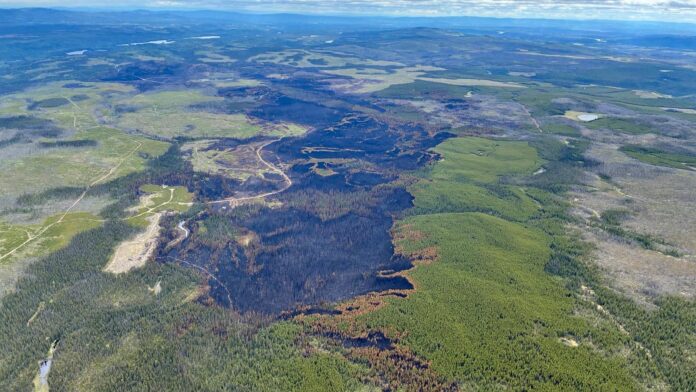

Provincial officials warn ongoing dry conditions and above-normal temperatures will likely lead to a challenging summer wildfire season.
Neal McLoughlin, superintendent of predictive services with the B.C. Wildfire Service, said the province is seeing drought patterns similar to those experienced during previous severe wildfire seasons.
“Our current drought conditions in 2026 are worse compared to this time of year in 2017, 2018 and 2021,” said McLoughlin.
More than 10,000 square kilometres were burned across the province in each of the years 2017 and 2018. The province saw close to 9,000 square kilometres burned in 2021, including a fire that destroyed much of the community of Lytton and killed two people.
McLoughlin said the northeast corner of the province, the central southern Interior, and the southern half of Vancouver Island currently have above-normal drought conditions.
“Regions with persistent drought will only require one to two weeks of normal summer weather to dry surface fuels, creating elevated fire danger and conditions that are conducive to extreme fire behaviour,” he said. “The amount of rain that’s required to mitigate drought conditions is unlikely this summer.”
Fire activity is expected to peak through July and August, though McLoughlin said it’s difficult to predict exactly when that peak will happen.
Forecasters have said much of B.C. can expect higher-than-normal temperatures this summer.
David Campbell, head of the B.C. River Forecast Centre, said the province’s snowpack was close to normal in April. But he said warm weather has caused snow to melt earlier, and as of June 1 the snowpack was at 64 per cent of what it normally is at this time of year.
He said about a quarter of the province is currently seeing high drought levels, with the hardest-hit areas in the South and Central Interior, the South Coast, and Vancouver Island.
“Week-to-week patterns that we see in terms of rainfall and temperatures are really going to drive what we see in the coming months,” said Campbell.

Forests Minister Ravi Parmar said the province is better prepared to tackle high-risk wildfires than it was just a few years ago.
He noted the B.C. Wildfire Service has operated year-round since 2022, and has incorporated new technology like night vision to allow crews to work overnight.
Clif Chapman, director of provincial operations for the BCWS, said new predictive technologies have also helped crews respond to fires faster.
“I think we’ve seen a significant increase in our ability to predict where fires will start, the potential of those fires and sending the right aggressive initial attack to those fires to try to stop those large catastrophic fires that we’ve seen in the past,” said Chapman.
Parmar said wildfire teams are ready for action across the province.
“Crews, aviation teams, and support staff have been working tremendously hard against the ongoing threat of wildfire, working literally day and night to manage fires as they appear, but also doing the important work of mitigation by reducing fuel,” said Parmar.
“It is important that everyone continues to remain vigilant and do what they can to be fire-smart and to fire-smart their homes and communities,” he said.
The B.C. Wildfire Service said warm and dry weather is expected to continue across B.C. this week, with potential for strong winds and lightning in eastern regions of the province.
The service said that, as of Tuesday, more than 300 wildfires had started so far this year, with more than 43 square kilometres burned.