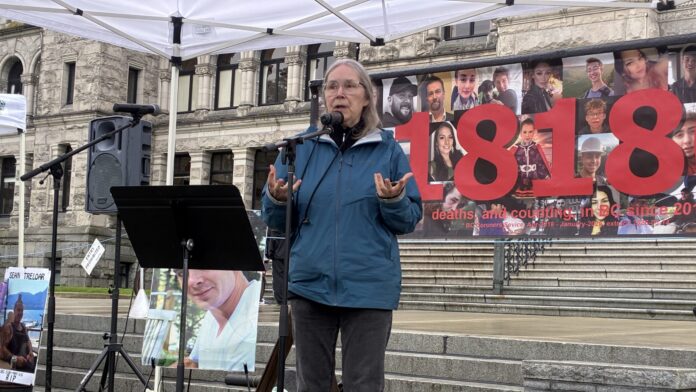

Dozens of people gathered at the British Columbia legislature Tuesday, some carrying signs and photos of their loved ones lost to drug overdoses.
They gathered to mark the 10-year anniversary of British Columbia declaring a public health emergency related to drug overdoses and deaths.
Many attendees expressed frustration with the government’s response to the ongoing crisis.
Ann Livingston, a long-time harm reduction advocate and founding member of the Vancouver Area Network of Drug Users, said the situation has only worsened since she began her work about three decades ago.
At least 18,000 people have died from unregulated drugs in B.C. since the public health emergency was declared.

On April 14, 2016, then-provincial health officer Dr. Perry Kendall served notice under the Public Health Act to exercise emergency powers in response to a significant increase in drug-related overdoses and deaths. The move gave health officials the power to collect and share more real-time data on overdose deaths.
Overdose deaths from unregulated drugs had nearly doubled from 528 in 2015, to 997 in 2016. The numbers continued to increase year over year, aside from a brief decline in 2019 that led provincial officials to express “cautious optimism.”
However, overdose deaths increased exponentially after the onset of the COVID-19 pandemic in 2020, reaching a high of 2,590 in 2023.
Since then, B.C. has seen a downward trend, with 2,318 deaths in 2024 and 1,833 last year.
Multiple First Nations in B.C. have also declared their own states of emergency in recent years. The latest data shared by the First Nations Health Authority (FNHA) says 143 First Nations people died from toxic drugs in the first six months of 2025.
That marked a nearly 40 per cent decrease from the same period in 2024. However, the FNHA said Indigenous people and communities are still disproportionately affected by the toxic drug crisis. It said First Nations individuals died at more than five times the rate of other B.C. residents. That rate was even higher for First Nations women.
“Ten years after B.C.’s declaration, the loss and grief continue in communities across the country, made worse by stigma, misinformation and politicization,” said the Canadian Drug Policy Coalition in a statement.
Nicole Luongo, the organization’s B.C. systems change co-ordinator, said the province’s response to the crisis has been hindered by politically driven decision-making.
“At this point, we have such robust data on what is required to end the crisis, and just a demonstrated unwillingness to do it,” said Luongo.

The province tightened restrictions around safer supply drugs last year. As of December, all patients taking prescribed alternatives must do so under the supervision of a health professional, such as a pharmacist or nurse. The changes were intended to ensure those who are prescribed the medications are the ones consuming them.
Health Minister Josie Osborne also announced in January that B.C. would not continue its decriminalization pilot, saying it hadn’t delivered the results the province hoped for.
B.C. received a three-year exemption in January 2023 from the federal Controlled Drugs and Substances Act. It allowed adults to possess up to 2.5 grams of certain illicit substances, including opioids, cocaine, meth or MDMA.
The province said pilot was intended to reduce stigma and help get more people into addiction treatment.
However, B.C. moved a little over a year later to restrict possession to private residences, shelters and treatment facilities. It came after backlash from municipalities, some of which proposed or passed bylaws to restrict drug use in public spaces.
B.C. Conservative mental health and addictions critic Claire Rattée called the province’s efforts at decriminalization and safe supply “ideological experiments.”
“They have not replaced it with any kind of strategy on how we’re actually going to get out of this crisis,” said Rattée.
Luongo said the issue lies not with decriminalization as a policy, but with B.C.’s implementation of it.
“The end of decrim, I would argue, was prewritten, because it was such an inadequate policy to begin with,” said Luongo. “Similarly, the failure to implement robust access to pharmaceutical-grade alternatives to the illegal drug supply, a.k.a. safe supply, is really the key driver of why this crisis persists.”
Advocacy organization Moms Stop the Harm also said it is “deeply disappointed” with the government’s response to the crisis.
“We know that deaths are driven by a poisoned, unregulated supply—not by a lack of care or worthiness. Yet, instead of scaling up evidence-based solutions that keep people alive, we continue to see hesitation, reversals, and decisions shaped by political pressure rather than public health,” the group said in a statement.

The concerns are shared by B.C.’s provincial health officer Dr. Bonnie Henry. Henry said during a roundtable discussion at the legislature on Monday that she was disappointed by the rollback of decriminalization and a lack of action on pharmaceutical alternatives.
“I absolutely believe there was political pressure, and it disturbs me immensely to see some of the political rhetoric that was used to demonize people who are most marginalized in our community,” said Henry.
“I think we need to regroup and look at how do we understand the principles behind these and how do we implement them in a way that is safer and addresses people’s very real concerns about public safety issues as well,” she said.
Osborne said on the same panel that the province is taking into account the “negative impacts” on communities in its response to the public health emergency. She said there is more work to do to reduce stigma around drug use.
Osborne said the data from the decriminalization pilot is still being collected and will help inform B.C. and federal policies going forward.