Experts and Indigenous leaders are raising concerns about a rise in residential school denialism as Canada marks the National Day for Truth and Reconciliation.
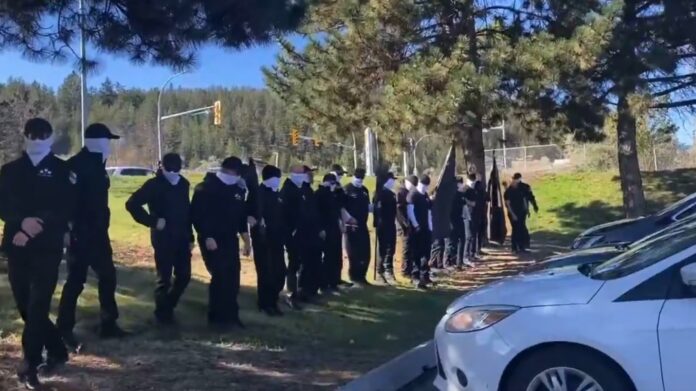
The rhetoric came to the forefront this week after images and video emerged on social media showing a group of white supremacists demonstrating on the Tk’emlúps te Secwépemc reserve, just east of Kamloops.
Photos show a group of about 20 people in black clothing and white face coverings on an overpass, carrying a banner that reads “got bones?”
The former Kamloops Indian Residential School has become a flashpoint for denialism rhetoric since 2021, when the Tk’emlúps te Secwépemc Nation shared preliminary findings from a ground-penetrating radar survey near the school.
The First Nation said the survey had identified about 200 areas of interest that could be burials and said the investigation would be ongoing.
Denialist and conspiracy rhetoric circulating online often falsely claims that the First Nation and media reported the confirmed discovery of mass graves, and alleges it’s part of a broader hoax to tear down Canada.
Sean Carleton, an associate professor of history and Indigenous studies at the University of Manitoba and co-editor of the book Truth Before Reconciliation: Confronting Residential School Denialism, said residential school denialism involves deliberately downplaying or spreading disinformation about the effects of residential schools in an effort to undermine public confidence in truth and reconciliation.
He said that can include claims that residential schools were “well-intentioned” at the time, that abuses are being exaggerated, or that only natural deaths occurred.
“All of these claims have been rigorously debunked for many years, the evidence is sitting there in plain sight, freely accessible,” said Carlton. “But these folks want to create a backlash to reconciliation, and sow seeds of division for personal profit or political gain.”
He said demonstrations like the one in Kamloops can serve as a recruitment tool for hate groups because they get more media attention.
B.C. legislators have also been criticized for championing denialist rhetoric.
Vancouver-Quilchena MLA Dallas Brodie was removed from the B.C. Conservative caucus last year for mocking residential school survivors on a podcast. She has frequently shared denialist rhetoric online. Her OneBC party produced a documentary last year that claimed to expose Canada’s “reconciliation industry.”
“This is very disturbing, because essentially what these politicians and far right activists are doing is denigrating dead Indigenous children for their own profit and benefit, and trying to distract Canadians from the hard work of putting truth before reconciliation,” said Carlton.
“This is the kind of stuff that we are seeing on the rise in the United States. These folks are just copying and pasting the far-right playbook and bringing it to Canada,” he said.
The Truth and Reconciliation Commission documented 3,200 confirmed deaths of residential school students through archival and institutional records, and hundreds more have been confirmed in the years since the commission’s final report.
Carlton urged people to read the commission’s report and challenge rhetoric that they encounter.
“We need to not get distracted by those who are trying to derail our progress,” he said.
Tk’emlúps te Secwépemc Chief Rosanne Casimir said the presence of white supremacists and white nationalists in the community was “deeply concerning” and said they were working with the RCMP to monitor the situation.
“White supremacy will not instill fear in generations of Survivors and Intergenerational Survivors who have already carried fear for far too long,” said Casimir.
“September 30 is a day for our community to come together to honour Survivors, remember the children who never returned home and support one another. As we prepare for the day, we are taking additional precautions and remaining attentive to activity in and around our community so that members can gather safely,” she said.