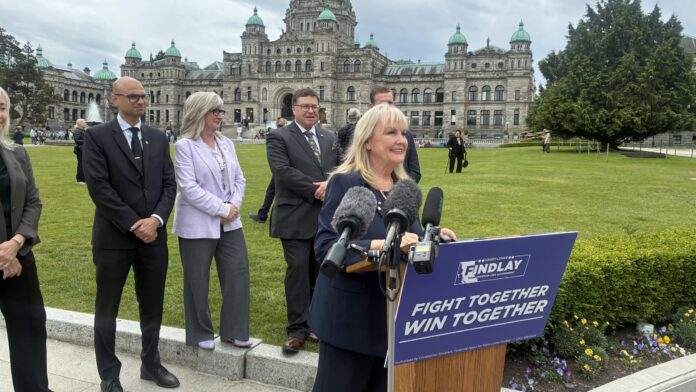

The B.C. Conservatives are set to hold a caucus meeting Monday after a tumultuous week for the party that highlighted rifts over Kerry-Lynne Findlay’s leadership.
Six MLAs have left the party this month, including five in the past week: Peter Milobar, Ian Paton, Rosalyn Bird, Teresa Wat, Brennan Day and Bruce Banman. All cited frustrations with Findlay and the direction she had taken the party since winning the leadership in May.
Banman was the latest to jump ship on Thursday, saying he had heard from many of his constituents that Findlay is “unelectable.”
Meanwhile, Findlay has faced legal and ethical questions over whether MLAs were offered anything in return for resigning their seat so she can run in a byelection.
Those allegations were compounded by widely reported leaked audio recordings that prompted further denials of wrongdoing from Findlay.
She also announced Wednesday that she had fired caucus operations director Apollo Chung, just over a month after he was hired.
The developments have left the Conservatives, the Official Opposition, facing significant internal turmoil weeks before the B.C. legislature is scheduled to return Oct. 5.
Stewart Prest, a political science lecturer at the University of British Columbia, said the recent wave of departures marks a significant blow for a party that just wrapped a hard-fought leadership campaign.
He said the driving forces are partly ideological as Findlay takes a more populist bent, but it also speaks to Findlay’s approach to interpersonal relationships within the party.
“Normally one expects the leader to go out of their way to let them up easy and build bridges with those that they have been at odds with. We saw Ms. Findlay do the opposite over the course of the summer, and this is the consequence,” said Prest.
He pointed to the departure of Wat, who said she was quitting because Findlay had still not publicly apologized for her comments in a leaked group chat in which Findlay alleged Wat was affiliated with the Chinese Communist Party. Findlay said she did apologize to Wat directly in a phone call, a claim that Wat contradicts.
“It’s one thing to have a narrowing of ideological appeal. You can still keep a core group of supporters. But if Ms. Findlay is alienating people because she is not managing the party effectively, that is a decline that can continue all the way down to the bottom,” said Prest.
Prest said the internal chaos could make it harder for the Conservatives to keep the focus on their work as Official Opposition, and further defections could even jeopardize that status.
“It is certainly possible that the Conservatives will continue to bleed support so that they are in danger of no longer being the second largest faction in the legislature,” said Prest.
Milobar and Paton said after leaving the caucus they intend to start their own centre-right party for voters who feel “politically homeless.”
They haven’t yet revealed a name for their party and, so far, none of their fellow former Conservatives have publicly committed to joining them.
Prest said a new centre-right party could be attractive to those voters who are tired of NDP governance but don’t like the populist direction of Findlay’s Conservatives.
“So the challenge for a new centre right party is to build an inclusive party that everybody who is currently swimming around in that centre area of politics…can see themselves voting for it,” he said. “That is a difficult challenge. It’s not insurmountable given the extreme reaction to the B.C. Conservative direction.”
Hamish Telford, an associate professor of political science at the University of the Fraser Valley, said on 1150 AM’s The Early Edition earlier this week that the departures from the caucus were predictable.
“[Findlay] wanted to lead a decidedly conservative populist party. Well, that’s fine, but it shouldn’t be any surprise then that more liberal-minded members of your caucus decide to leave,” said Telford.
“The old formula for uniting the right, in my opinion, has disappeared,” he said.
He said the key to success for a centre-right party would be to focus on the fiscal matters that businesses care about, and not get bogged down in divisive social policy.
Telford said, with CentreBC already occupying that political space, it could get crowded.
“If you’ve got more than two parties on the centre-right dividing the vote, that makes the path to power for the NDP all the easier,” he said.
But he said Premier David Eby shouldn’t expect to coast on the wave of Conservative chaos.
“He has to focus on the things he can control, that’s his government, and not take for granted that the opposition will always be fractured,” said Telford.