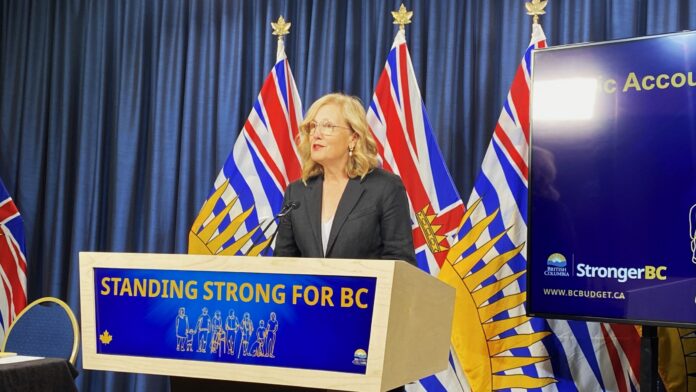

British Columbia’s Finance Minister Brenda Bailey said the deficit for the 2025-2026 budget year was $7.7 billion, about $3 billion lower than projected thanks to higher revenues and spending reductions.
The government had forecast a $10.9-billion deficit in its initial budget for the fiscal year, which ended in March.
Bailey said Monday that revenues were close to $2.9 billion higher than expected, with much of that revenue coming from a major settlement with tobacco companies.
B.C. received an initial $936 million payment in August 2025, out of a total $3.6 billion settlement payment.
The full amount is scheduled to be paid to the province over the next 18 years, but the province logged the full remaining amount of the settlement toward the 2025-2026 fiscal year.
The settlement revenue partly offset a $2.4-billion decrease in revenue related to the elimination of the consumer carbon tax in 2025.
Meanwhile, infrastructure spending on projects such as hospitals and transportation was about $4 billion lower than forecast as some projects were delayed, a process Bailey referred to as “slippage.”
“This is not about cancelling any projects. All of these projects are going ahead,” said Bailey. “Slippage happens every year.”
She pointed to supply chain issues for steel and aluminum and workforce shortages.
Bailey said the uncertainty caused by the Trump administration’s trade war has made planning for the future difficult.
“We had to roll up our sleeves, we had to pivot, and we did,” she said.
Bailey said B.C.’s real GDP rose by two per cent in 2025, up from 1.2 per cent the previous year.
She touted the province’s debt-to-GDP ratio as being the second-lowest in Canada at 26.3 per cent. That was lower than the forecasted 26.7 per cent in the initial budget.
The debt-to-GDP ratio is a key metric used by credit rating agencies and investors, and a lower ratio is generally an indicator of a healthier economy.
Total provincial debt for the year was $154.8 billion, an increase of around $20.9 billion from the previous year.
Taxpayer-supported debt was up by $18.4 billion to $117.4 billion.

B.C. Conservative Finance Critic Peter Milobar criticized the deferral of capital projects. He noted the government also said this fiscal year it would be “repacing” several projects, including five health care projects.
“So cumulative, while the government insists that they are actually investing in British Columbia’s infrastructure, they are actually continuing year over year over year not delivering on what they promise,” said Milobar.
Milobar alleged the inclusion of the entire tobacco settlement in the 2025-2026 fiscal year serves to artificially bring down the deficit number and present a better fiscal picture while Premier David Eby is slumping in the polls.
The province is set to present the first quarter update for the 2026-2027 fiscal year in September. The initial budget forecast a record deficit of $13.3 billion for the year.