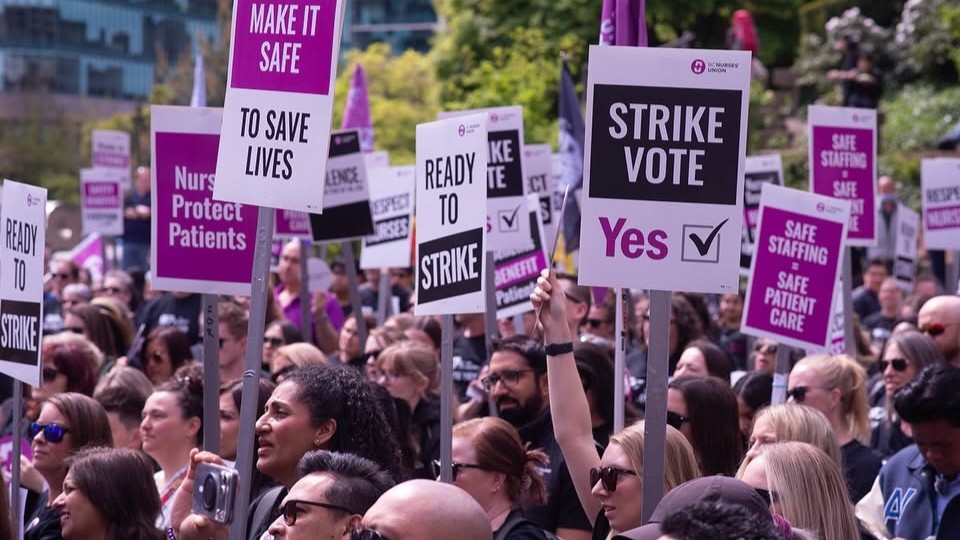

The B.C. Nurses’ Union (BCNU) said negotiations with the province had reached an impasse and it would expand picket lines to more hospitals starting this weekend.
The union said bargaining had resumed Monday afternoon, but the talks broke down throughout the week.
Picket lines went up Tuesday at Vancouver General Hospital, and expanded Thursday morning to Surrey Memorial Hospital and Jim Pattison Outpatient Care and Surgery Centre.
The union said members would begin picketing Sunday at Victoria General Hospital, followed by Nanaimo Regional General Hospital on Monday and Royal Jubilee Hospital and South Island Surgical Centre in the Greater Victoria area on Tuesday.
“We have reached a critical point in this dispute,” said BCNU Adriane Gear. “Nurses have bargained in good faith, and we’ve taken measured job action while maintaining essential services to protect patient safety.”
The provincial government has set a mandate for public-sector bargaining units that includes an offer of a three per cent annual general wage increase over four years.
Gear said the mandate doesn’t go far enough address the needs of nurses.
“The provincial government can end this dispute. It can provide health employers with a mandate that retains nurses, strengthens public health care and prevents further disruption. We are calling on government to act,” she said.
The Health Employers Association of B.C. (HEABC) confirmed in a statement the parties have been unable to reach a new tentative agreement in meetings this week.
“Progress was made at the bargaining table on some important issues, but substantial gaps that exceed the government envelope remain,” said the HEABC.
“HEABC remains available to return to the bargaining table at any time and continues to believe the best path forward is through the established bargaining process,” it said.
B.C. Health Minister Josie Osborne said in an emailed statement the province is committed to a fair deal for nurses.
“Nurses’ priorities are our priorities too – hiring more nurses, implementing minimum nurse-to-patient ratios to strengthen patient care and support quality environments for nurses, and protection from workplace violence. While we’ve made progress together on these priorities, there’s no question there’s more to do,” said Osborne.
“The Health Employers Association of BC is ready to return to the table at any time and it’s our expectation that they will continue to work with the union to reach an agreement that is fair for nurses and sustainable for the public health-care system they support,” she said.
Osborne said people should not delay seeking emergency or urgent care due to concerns about the strike.
“Those with the most urgent needs are being seen first, and essential services remain in place at every site – including during picketing,” she said.
The BCNU launched job action on July 2, saying nurses across the province would refuse to perform non-nursing duties, like cleaning or answering phones, as well as any unnecessary overtime.
The job action followed members’ vote to reject a tentative agreement reached with the province in May.
BCNU said Thursday it had received more than 2,300 reports alleging employers had intimidated members who were participating in job action.
“Reports include threats of discipline, warnings that nurses could face complaints to the BC College of Nurses and Midwives, and pressure to perform non-nursing duties and work mandatory overtime,” said the BCNU in a press release.
The union said it has filed an unfair labour practice application with the BC Labour Relations Board.
B.C. Conservative labour critic Kiel Giddens said in a statement the negotiations should not have gotten to the point of strike action.
“After years of empty promises, nurses are done waiting for a government that treats their concerns as an afterthought,” said Giddens.
Health critic Anna Kindy said B.C. is failing nurses.
“This government is trying to save money on the backs of our overstretched frontline nurses. That’s not just unsafe for nurses, it’s unsafe for patients and it’s what leads to burnout,” said Kindy.
“Training and recruiting more nurses will not fix this shortage if government can’t retain the nurses it already has,” she said.