
My word, a Canadian’s use of the English language is bedazzled with meaning, context, and historical significance.
In Canada, we celebrate new Canadianisms, as they reflect our national intertwined-ness.
Recently, the Oxford English Dictionary (OED) released its Canadian English additions to commemorate the first of July or Canada Day.
Editor and lexicographer on the new words team Dr. Jennifer Hurd said the OED tries to include words and phrases from varieties of English all over the world.
“Not just British or American, but Canadian, New Zealand, Australian and Nigerian. English is spoken all around the world, so we try very hard to include words reflective of everywhere English is spoken. As part of our World English Program, we regularly look at evidence for words from different varieties of English,” Hurd explained.
In the most recent update, Hurd added a few new Canadianisms were added, including “elbows up,” “kitty-corner,” and “point form.”
“Which are predominately in Canadian use,” noted Hurd.
According to Hurd, the OED maintains a massive database, which is basically a watch list of possibilities or possible candidates for inclusion. “I think last time I looked at it, there were some 60,000 suggestions on this watch list. We’ll periodically review the evidence for these.”
“What we’re looking for is a wide-variety of evidence from a lot of different independent sources over a reasonable period of time,” Hurd shared. “If you think about it a little bit like writing a biography of a word, the OED is a historical dictionary. We try and tell effectively, the life story of a word.”
Hurd or other new words editors will receive suggestions for words or phrases, which will be researched extensively.
“I will look for the earliest use of the word, the earliest evidence in English I can possibly find. I will look at how it’s been used over time and how it’s most typically used now. Once I’ve done all that research, I will draft a new entry,” Hurd said.
The OED was founded in the 1800s, after the proposal was put before the Philological Society in London and the compilation was then considered, The New English Dictionary.
“It became associated with Oxford University Press in 1879, when the University Press agreed to publish it. It took much longer to complete than anticipated because of the volume of research and work involved. It was founded as a historical dictionary. The idea is it documents the history of the English language as it is and how it has been,” Hurd explained. “We don’t set out to tell people how to use language. We document how it’s used and has been used. The core of every entry is what we call a ‘quotation paragraph,’ which is a selection of real examples from writers and speakers of English throughout history that gives typical examples of how a given word has been used over time.”
It’s very important for new entries in the OED to have that historical research and evidence behind it.
“The first edition took a very long time to finish. It was 1928, I believe, the first edition was finally finished. The original chief editor, regrettably, did not see it completed,” Hurd noted.
The website is constantly updated every three months, Hurd said. “Every three months, we publish new words, but we’re also progressively revising the text of the second edition for the third edition. Those revisions began in the nineties and are still ongoing because it’s a massive project.”
Every year, editors add or revise about 15,000 entries, Hurd added. “Anything new that’s added is always accessible online in a way that would be much more difficult in a print version. I have a copy of the second edition at home, and it’s 20 volumes. It’s fabulous to read through, but it would be much harder to keep that up-to-date. Whereas, if you access it online through our website, many libraries or universities have access, or you can also buy a personal subscription and you’ve got the most up-to-date version, and you’ve got access to the latest revisions and the latest editions.”
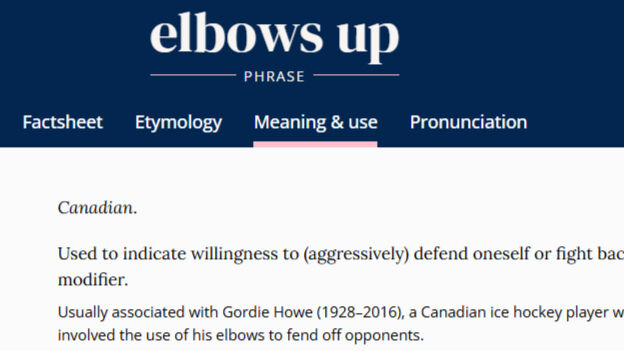
One new addition to the OED is the phrase, “elbows up,” which has been associated with hockey.
“A defensive stance with the elbows raised is the image evoked there. It’s a phrase used to indicate willingness to aggressively defend oneself,” Hurd explained. “It’s had a moment in the spotlight in the last couple of years, but we’ve actually found evidence for it, not in a hockey context, going back to at least 1985. We have an example from 1985, which is in the context of a leadership election for a provincial political party, and a battle for delegates is described as an ‘elbows up’ affair.”
“That’s more than four decades of use, even though it’s become quite popular more recently,” Hurd added.