
The British Columbia legislature is heading into its summer break after a parliamentary session that saw the NDP government reacting to pressure on multiple fronts, including Indigenous reconciliation, private property rights, pipeline tensions with Alberta and a controversial budget.
The government’s handling of planned amendments to the Declaration on the Rights of Indigenous Peoples Act (DRIPA) became a particular flashpoint.
The 2019 legislation was intended to serve as a roadmap for Indigenous reconciliation in B.C.
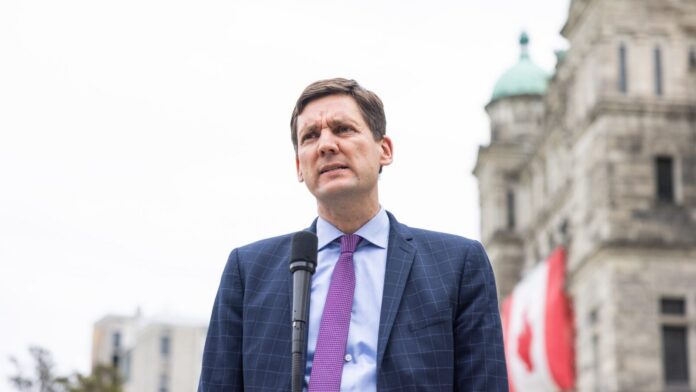
After a December B.C. Court of Appeal decision in favour of the Gitxaala First Nation, Premier David Eby said amendments to DRIPA were urgently needed to protect the province from litigation and that legislation would be tabled during the spring session.
A key part of the court ruling said that disputes about whether provincial laws align with the reconciliation framework can be decided by courts.
Eby later backed off his push for permanent changes to DRIPA after intense opposition from First Nations leaders. He said the province would instead propose a temporary suspension of parts of the legislation while it seeks input from the Supreme Court of Canada on the Gitxaala ruling.
In April, the government once again pivoted and said no DRIPA bill would be tabled during the spring session. Eby said the province and First Nations have committed to working together on the issue, with the hope of finding a solution, but left the door open to possible legislation in the fall.
The B.C. Conservatives have maintained that DRIPA should be repealed entirely.
Stewart Prest, a political science lecturer at the University of British Columbia, said the NDP government’s initial push to amend DRIPA appeared to be a knee-jerk reaction.
“I do think where they have landed now, which is to take a step back and not rush to a solution, but rather to consult with Indigenous peoples and hopefully come up with a more considered and durable solution, that is the right approach,” said Prest. “The government is going to have to take more definitive action soon.”
The B.C. NDP have also faced blowback from its budget that featured a whopping $13.3 billion deficit for 2026–27 and expansions to the provincial sales tax.
Prest said the budget failed to offer a clear vision for the province’s future.
“That seems to be a problem for the NDP on many fronts, that vision thing of, ‘Well, we’re in a difficult situation now, but how are we going to move forward out of it?'” said Prest.
He said the B.C. government has also been playing defence on issues like Alberta’s proposal for a new pipeline for the B.C. coast.
B.C. has been largely left out of discussions as Alberta has negotiated agreements with the federal government laying out a potential pathway to a pipeline project.
Eby has staunchly opposed any pipeline to B.C.’s north coast, as it would require lifting the federal moratorium on oil tankers in northern waters.
“It’s hard to really sell your own agenda when you’re either backtracking that agenda or trying to defend your place in the conversation,” said Prest. “And so I think the summer can’t come quickly enough for the NDP. They’re going to look for a way to reset these conversations and move back towards the things that they want to talk about.”

B.C. Government House Leader Mike Farnworth disputes that B.C. has been entirely on the back foot this session.
He said if he were to describe the session in one word, that word would be “standard.”
“We’ve made, I think, significant progress when it comes to issues that matter to British Columbians around health care, for example, around affordability, around housing,” said Farnworth on Thursday.
Farnworth also responded to criticism that relatively few pieces of legislation passed this spring session. He said a key focus of the spring session is typically the budget.
“In the fall, we will have more legislation, and there won’t be a focus on the budget because the budget’s been dealt with in the spring,” he said.

B.C. Conservative interim leader Trevor Halford said the B.C. NDP’s multiple pivots on amendments to DRIPA have impacted economic certainty in the province.
“I think that [Eby] has continued on that file to overpromise and underdeliver,” he said. “I’m not optimistic that we’ll have a solution in the fall either, at least a legislative solution.”
Halford said he also wants the B.C. government to get on board with Alberta’s proposal for a new pipeline, saying the Eby government has been “caught flatfooted.”
“It’s very disheartening and concerning to me that we have not been at the table for those conversations,” he said.

B.C. Greens Leader Emily Lowan said the party has no regrets about tearing up their co-operation agreement with the NDP government in February. She said there has been a “string of broken promises” this session.
“[The NDP] have lost their way and they’re just chasing moderate voters on issues like DRIPA,” said Lowan. “What we’ve seen is complete cowardice on behalf of the NDP and constantly capitulating to conservative fear-mongering.”
She left the door open to working co-operatively with the NDP again in the future, but said it would take a “radical change of heart.”