
Sarabjit Kaur Sidhu was riding to her farm job on a rainy day in March 2007 when the overloaded vehicle crashed near Abbotsford, killing her and two other women.
Fourteen other farm workers were injured in the crash.
It was later found the van had few seatbelts and shoddy tires. The van’s driver also did not have a proper license and had obtained a fraudulent safety permit to operate the vehicle.
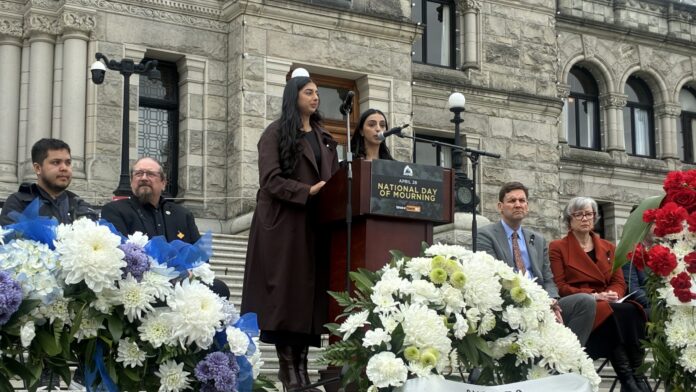
Avneet and Avnoor Sidhu shared their story of growing up without their mother at a “Day of Mourning” ceremony for workers on Tuesday.
The annual ceremony to honour people who were killed, injured or made sick by their work usually takes place in Vancouver, but it was held outside the B.C. legislature this year.
The sisters and their family now work with the BC Federation of Labour (BCFED) and WorkSafeBC to advocate for better workplace safety.
“This was not an accident, it was a failure. A failure of systems, a failure of accountability, a failure to see the humanity of the workers who feed this province every single day,” said Avnoor Sidhu.
The BCFED says in its annual report there were 138 work-related deaths in B.C. last year.
More than half of those deaths were due to occupational disease, including a total of 36 asbestos-related deaths.
Also in 2025, 41 workers died from traumatic injuries, and 18 died in motor vehicle incidents.

BCFED president Sussanne Skidmore said there has been recent progress in B.C. for worker safety, including improved crane safety requirements and expanded cancer coverage for firefighters.
But Skidmore said there are still too many loopholes for temporary foreign workers in Canada that put workers at risk.
There are thousands of temporary foreign workers in B.C., many working in the agriculture, hospitality, health care and construction sectors.
Amnesty International said in a January 2025 report that Canada’s temporary foreign worker program increases racialized workers’ risk of exploitation and human rights abuses.
Skidmore said there should be better pathways to citizenship for temporary workers.
“You’re good enough to work in this country, you’re good enough to be safe in this country, and you’re good enough to live in this country,” she said.
Premier David Eby also reiterated his criticism of Canada’s temporary foreign worker program in his speech at the ceremony, claiming it exploits workers by tying them to a single employer.
Avneet and Avnoor Sidhu agreed it’s an issue that they have seen come up a lot in their advocacy work.
“There’s really no safety when it comes to them,” said Avneet Sidhu. “They’re treated like third-class citizens with very little rights.”
B.C passed the Temporary Foreign Worker Protection Act in 2018, adding new rules for employers and recruiters of foreign workers.
But B.C. Labour Minister Jennifer Whiteside acknowledged more work is needed to ensure temporary foreign workers have access to proper health care and safety protections.
“We need fundamental change to that program to ensure workers are not exploited,” she said.