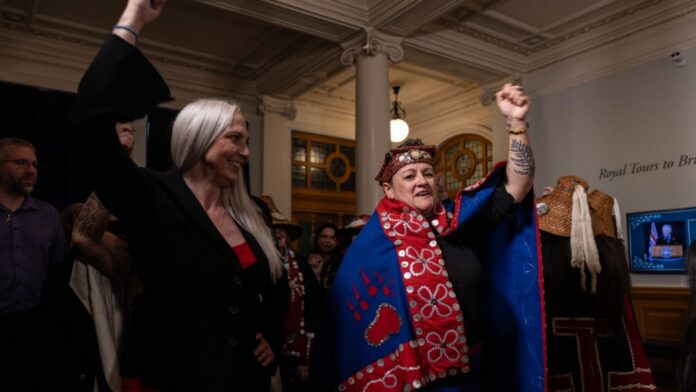

British Columbia has tabled legislation to implement a treaty with K’ómoks First Nation, marking a major milestone in a process that began more than 30 years ago.
The province tabled a treaty implementation bill Tuesday, the first step toward ratifying the agreement.
“[Treaties] bring prosperity to the region. They bring certainty and predictability in terms of how we work together,” Indigenous Relations Minister Spencer Chandra Herbert told reporters ahead of the bill’s introduction.
K’ómoks First Nation entered treaty negotiations with Canada and British Columbia in 1994, reaching an agreement in principle in 2012. Members voted in favour of the treaty last year.
The treaty confirms the First Nation owns about 34 square kilometres of land on central Vancouver Island’s east coast and provides an option to purchase a further 16 square kilometres from the province.
It would enable the First Nation to transition from operating under the Indian Act and establish its own laws in several areas. It also includes a process to develop shared decision-making agreements on parks, wildlife, fish and water.
“Today is not the end of the journey,” said Nicole Rempel during an event at the legislature. “It’s a meaningful step forward and an important step in implementation and toward a future where our nation can fully realize its potential.”
David Eby called it an “historic” day.
“This work that we’ve done together reflects a choice…between conflict and refusal to recognize rights, and the choice to co-operate, to sit down and find a path forward together,” he said.
The proposed treaty lands overlap with other First Nations’ traditional territories.
Members of the Wei Wai Kum First Nation near Campbell River, British Columbia have asked the province to pause ratification of the treaty to allow amendments addressing overlapping interests.
The province said several steps remain before the treaty can take effect. After the implementation bill is debated and passed in the legislature, the treaty must still be signed by K’ómoks First Nation, British Columbia and Canada, and reviewed by the federal Parliament.
The First Nation would also have the option to enter agreements with neighbouring First Nations, which could be listed in the treaty.
“The introduction of the treaty legislation is not the finish,” said Spencer Chandra Herbert. “In fact, it continues the process, and I think it makes clear what conversations we need to have with those neighbouring nations.”
Rempel said the First Nation is committed to working with neighbouring nations as the process moves forward.