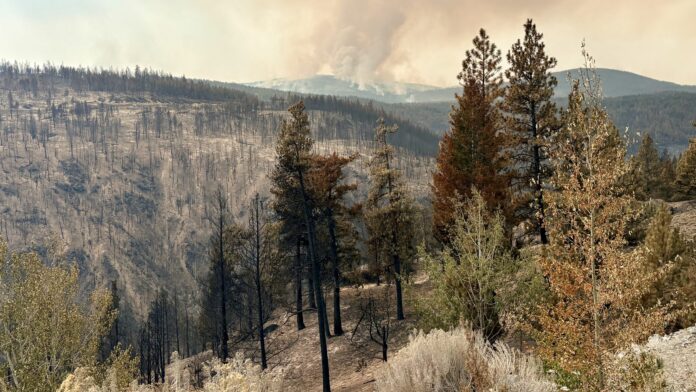

As peak wildfire season begins to wind down, land and wildlife experts say there’s a long road to recovery from this year’s intense wildfires that forced thousands of British Columbians to evacuate their homes.
Wildfire restoration expert Angela Kane says she knows the high toll of being displaced by wildfire.
Kane is the CEO of the Secwepemcul’ecw Restoration and Stewardship Society (SRSS), an Indigenous-led wildfire recovery organization that formed after the devastating 2017 Elephant Hill fire that burned close to 200,000 hectares near Ashcroft, B.C.
Kane said this summer’s wildfire evacuations brought back memories of being forced to flee her own community nine years ago. She said she still has post-traumatic stress from the experience.
“During the 2017 [fire], I think it was kind of a surreal moment. We never thought that it would come that far that quickly,” said Kane.
Kane said the scale of the destruction is also surreal, as B.C. sees such intense wildfires happening more frequently due to climate change.
Recalling her experience flying over the landscape burned by the Elephant Hill fire, Kane said she was stunned by the devastation.
“It’s like a moonscape,” she said. “What we saw was areas that were burnt so hot that it destroyed the soil. It was like glass. There was no way for water to absorb through it.”
“When you have these types of wildfires go through, it’s not a fire and then it’s over. The impacts after, for years, is intense,” she said.
Kane said the first task for the society’s restoration efforts is finding areas where the soil has not been badly damaged and working with First Nations to determine where and what to plant.
“What we’re finding is some of the communities want areas left as grassland. So they don’t want any trees planted in there because over years of no more thinning or managing the forests they become overgrown,” said Kane.
She said workers also face risks from burned trees that remain standing and could fall.
Kane said her group takes care to plant a mixture of coniferous and deciduous trees suited to the local biogeoclimatic (BEC) zone, which is how B.C. classifies different ecosystems in the province.
She said 2026 is the first year they’ve been planting shrubs and medicinal plants back onto the land in the Elephant Hill fire area.
“When you look at a healthy ecosystem, it has that mixture of coniferous and deciduous, and it has the understory, which is the shrubs and the plants,” she said.
However, Kane said maintaining a seed stock has been challenging, as climate change impacts what can be harvested from a particular BEC zone.
“And every year I’m challenged with, do we have enough seed to plant or to grow? And it’s not getting any easier. It’s actually getting more and more difficult,” she said.

Kim Dunn, WWF-Canada’s lead specialist for habitat stewardship, said wildfire can be a natural part of ecosystems in B.C., but climate change is driving wildfires that are larger, faster and more destructive.
WWF has partnered with SRSS on restoration work. Dunn said that when you look at post-wildfire landscapes like the Elephant Hill area, there’s almost nothing left.
“There’s maybe some charred remains of what used to be a tree kind of here and there. But there’s not much left, and that’s part of what makes it so hard to recover from,” she said.
“With larger, more intense fires, it is increasingly more difficult for wildlife to escape fires because they’re just moving so fast,” said Dunn. “And we know that when fires are very, very intense, we don’t see things come back and regenerate naturally all the time anymore, as we used to see with some more natural wildfires.”
She said smoke inhalation and loss of habitat and food sources also have lasting impacts on animal populations.
“A good example of this is some of the lichen that we know that our woodland caribou here in B.C. really like to eat. That takes a really long time to recover after a wildfire,” said Dunn.
Dunn said the approach to restoration differs for every ecosystem, but she said the biggest barrier is a lack of funding.
“It’s very expensive. So as we face increasing wildfires and other instances where we need to restore landscapes or coastal areas even after events like this happen, we need an enormous amount of support,” she said.
“We know we’re in a situation now where we can expect things to get worse,” said Dunn. “We see an increase again in the size, the frequency of fires. We see more intense fires and we have to be prepared for that going forward. And it means that we need investment from the provincial government, but also other governments too and other organizations.”
She noted WWF is holding its Climb for Nature event at Vancouver’s BC Place on Oct. 24, where participants run up and down the stadium’s 3,000 steps to raise funds for conservation efforts.
Kane agreed that more funding is crucial, but said policy changes are also needed.
“We did 292 page report on the Elephant Hill Wildfire lessons Learned back in 2017, which outlined to the provincial government, as well as BC wildfire, calls to action and recommendations,” said Kane. “Some they did half-heartedly and some they didn’t. And for me right now, again, seeing these [fires], I am just so frustrated in the fact that our provincial government and BC Wildfire still to this day cannot get it together.”
Kane said she wants to see the province put more funding into forest management, especially around rural communities.
It was an issue Premier David Eby acknowledged last month, as thousands were evacuated from Summerland. He said there would be more discussion about logging practices near communities and requiring new developments to be more resilient to wildfires.
The BC Wildfire Service said Friday that 1,383 wildfires had been recorded in the province this season, burning more than 475,000 hectares.
The total area burned remains below the totals recorded in each of the previous three years and is slightly below the 20-year average of 530,041 hectares.
The service said shorter days and more fall-like weather are arriving across the province, but fire safety remains important and people should continue to use caution with activities that could cause a spark.