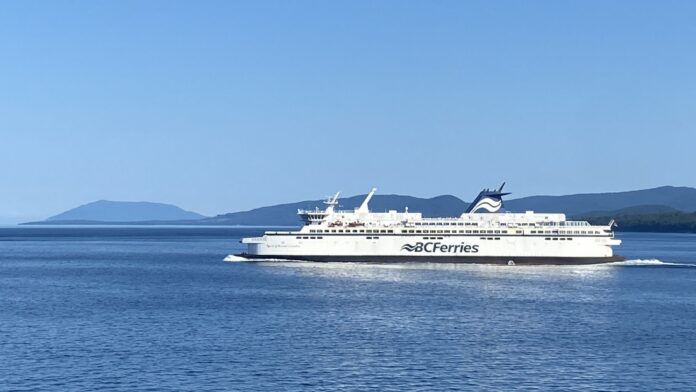

A coalition of shipbuilding unions says BC Ferries’ decision to build four vessels in China instead of Canada may have cost the economy $1.5 billion and bypassed $413 million in revenues for government.
The cost analysis was done by the Centre for Future Work and released Thursday by a coalition of more than 15 unions connected with the shipbuilding industry. The coalition launched a new campaign last week calling for future ferries to be built domestically.
The report estimates that if the vessels were built in Canada, about 85 per cent of the economic gains could have been in the province.
It also said the construction and associated activities could have generated more than 10,000 person-years of work, most of those in B.C.
Economist and report co-author Jim Stanford notes the figures may not be accurate, as BC Ferries has not revealed cost details of the contract announced last year with China Merchants Industry Weihai Shipyard.
Stanford said they tried to “reverse engineer” an estimate, based on available figures, including the financial support BC Ferries is getting from the Canada Infrastructure Bank.
He said they believe the cost of the four vessels would be $1.6 billion, but said that estimate may be conservative based on input from industry experts.
BC Ferries operates as an independent company with the provincial Crown as the sole shareholder. It said it has decided to keep the costs of the deal under wraps so as not to compromise any future deals.
The company had said the decision to build in China followed a “rigorous global procurement process” that was open to Canadian shipyards. It said two Canadian shipyards pre-qualified, but neither submitted a final proposal.
Premier David Eby said at the time that the province couldn’t afford a long wait for the new vessels, as they were desperately needed to replace the oldest ferries in the fleet.
Stanford argued the decision shows a failure of planning and investment by BC Ferries and governments.
“For BC Ferries to throw up their hands and say, well, we have this request for proposals and no one in B.C. submitted it so there’s no choice, it’s just an abject cop out,” said Stanford.
“The purpose of this report is not so much to re-prosecute the decision to bring these four ships in from China. I think most people have accepted that decision was made, no matter how much we dislike it,” said Standford. “The purpose of this report is to say what the costs of doing that were, so that those are front and centre, and to say, looking forward, how do we make sure that never happens again?”
BC Ferries plans to introduce up to seven new major vessels in the coming years, with four currently approved and being built in China.
Brynne Bourke, executive director of the BC Building Trades, said the coalition wants to see a timeline for when BC Ferries plans to procure its future major vessels, so the industry can scale up capacity and plan bids.
The report calls on the provincial government to bring together ministers and stakeholders on a task force to plan the future of shipbuilding in the province.
It also recommends the province revise BC Ferries’ mandate to maximize the economic benefits of domestic procurement and accelerate ferry electrification.
“We’ve got to challenge BC Ferries’ mandate and this assumption that they’re only there to provide ferry services for as cheap as possible,” said Stanford. “Cost minimization is not the appropriate mandate for a public service. You also have to look at the social costs and benefits based on things like their procurement decisions.”
The report recommends the task force explore a consortium model in which multiple shipyards co-operate on major projects. It said the province could also take equity stakes in future ventures to ensure that the public shares in the profits of future shipbuilding.
Stanford said B.C.’s strategy must also include boosting training and apprenticeship opportunities for new workers in the shipbuilding industry.
BC Ferries said Thursday it supports growing Canada’s shipbuilding capacity, adding that the operation of the new vessels will generate local economic benefits.
“For the four new Summit Class vessels alone, we anticipate investing more than $240 million locally on refits and scheduled maintenance in their first 10 years of service, and more than $1 billion over their expected 45-year lifespans,” said BC Ferries in a statement.
“We’ve been clear about what is required to responsibly build future ferries in Canada: domestic shipyards with the capacity to build the vessels we need, certainty on cost and delivery schedules, and assurance of vessel and shipyard performance and quality,” said BC Ferries. “Even with those conditions in place, building locally is expected to cost significantly more and that additional cost would need to be funded.”
It said that additional funding can’t come from BC Ferries and customers alone and government and industry need to be part of the solution.
Adrian Dix, acting Minister of Jobs and Economic Growth, said he appreciates the coalition’s report and he wants to see more ferries built in B.C.
He said the province is working with the federal government to strengthen B.C.’s broader deep marine sector, including growing shipbuilding and vessel production capacity.
He pointed to the B.C. government’s current Look West economic strategy for the maritime sector, which is largely focused on securing more federal defence vessel contracts.
“The opportunities highlighted in this report reinforce the importance of continuing this work. Building more ferries and deep marine vessels in B.C. is good for workers, good for communities, and good for Canada’s economy,” said Dix.
The ministry added that it would continue advocating for federal investments that support shipbuilding and marine industrial capacity.