
British Columbia’s government has issued a second protection order for the Salmon River watershed, as some wildlife advocates question whether the first order should have been rescinded.
The latest protection order was issued on Wednesday (Aug. 19). The ministry said continued low stream flows were threatening the survival of more than 200 adult Chinook salmon that had returned to the watershed to spawn.
The order restricts the use of water for irrigation of forage crops like alfalfa and hay, as well as lawns, fairways, gardens and industrial purposes.
The ministry said the Water Sustainability Act allows water to be used during a protection order when necessary for firefighting.
It was the sixth time the province had issued a temporary protection order for the Salmon River since 2021, according to the ministry.
The ministry initially issued an order July 28, saying severe drought in the Thompson-Okanagan region was threatening chinook salmon populations.
The province ended the order Aug. 8 despite continued dry conditions and low stream flows.
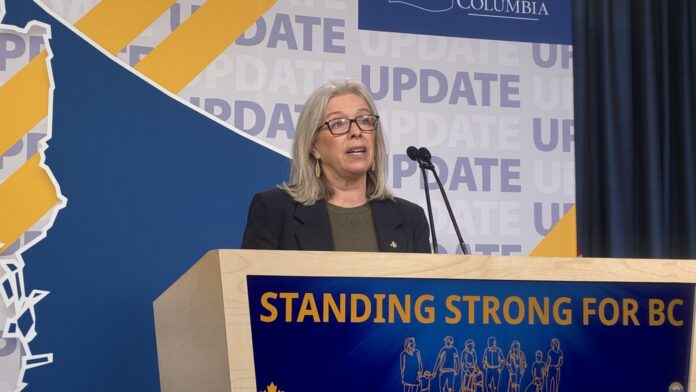
“This temporary protection order was put in place to protect Chinook salmon during extremely challenging drought conditions, but I have also heard clearly from farmers and ranchers about the significant effects these restrictions are having at a time that they are also dealing with wildfire risk,” said Minister Randene Neill in a statement at the time. “Because of this, I’ve made the decision to rescind the order, effective immediately.”
Data from the B.C. River Forecast Centre show that water levels in the Salmon River stabilized and then increased after the initial order came into effect last month. Water levels began to fall again once the order was rescinded.
Neill said Thursday that the protection order needed to be lifted to allow producers in the area to take measures to proactively protect their properties as the Bradley Creek wildfire burned in the North Okanagan.
She noted the provisions in the Water Sustainability Act that allow water use for firefighting only apply if there is an immediate risk.
“We made the difficult decision after another meeting with producers on the Salmon River to reinstate that TPO, to do our best to save the salmon,” said Neill. “It shows that there are competing interests in B.C., and it’s my job to try to balance those interests as best I can.”
The B.C. Wildlife Federation (BCWF) said in an Aug. 13 letter to Neill that the decision risked undermining the purpose of fish protection orders.
“By rescinding that protection order, what we were really worried about is people going, why should we care? If the province is going to change its mind that quickly, then why should we be good stewards?” said BCWF executive director Jesse Zeman on Thursday. “And we’re definitely seeing some fallout in terms of relationships and collaboration that’s a result of these changes in decision.”
Zeman said he was relieved that the province had renewed the protection order.
“We were extremely worried that we were going to see that river or at least parts of that river go dry, which would have lasting effects on fish populations in the area,” he said.
He acknowledged the difficulties in finding a balance between ensuring farmers and other licensees have the water they need during severe drought conditions, and protecting the at-risk fish populations.
“The trade-off here is multi-generational impacts on what are already endangered Chinook salmon,” said Zeman.
“We don’t see it as a binary [where] it’s either this or that. We see it as one of these things where we need to figure out a way to make sure there’s water for both,” he said.
Zeman said there needs to be more provincial investment in proactive measures and stewardship work to mitigate the impacts of drought in the province.
He pointed to the BCWF’s partnerships with local groups and First Nations to create barriers similar to beaver dams to help hold more water on the landscape.
Zeman said investments are also needed in more efficient irrigation systems and technology to help users conserve more water.
Neill said the province is committed to looking at long-term solutions for the Salmon River and Bessette Creek in the North Okanagan, which has also been subject to multiple protection orders in recent years.
“It’s going to take all of us together looking at ideas,” she said.