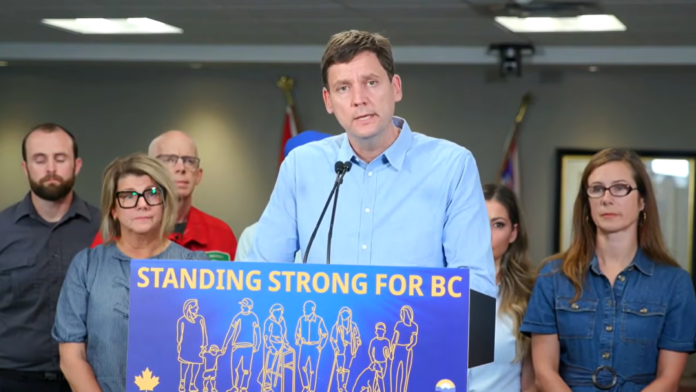

Premier David Eby says B.C. may need to rethink how it protects communities from wildfires as intense and unpredictable fires become more frequent.
He said there needs to be conversations about how to reduce wildfire risk in areas where communities meet wildland, known as wildland-urban interface areas.
“I suspect that will be one of the major takeaways from this fire season is a deeper conversation about interface areas,” said Eby during a visit to Penticton on Wednesday.
Thousands of evacuees from the Summerland area are sheltering in Penticton after being forced from their homes by the fast-moving Bald Range wildfire.
Eby said there would be discussions around logging practices around communities and requiring new developments to be more resilient to wildfires, with measures like sprinkler systems and fire-resistant exterior cladding.
“Our historic practice of preserving the trees around local communities, while logging operations are happening a little further away, has had the unintended effect of creating a buildup of fuel around communities in the interface areas,” said Eby.
He also touted some of the positive messages he has heard from local leaders about B.C.’s FireSmart program, which teaches communities and residents about how to reduce wildfire risk.
FireSmart funding has fallen in recent years. The province has provided about $175 million for the program since 2018, according to the Union of B.C. Municipalities (UBCM).
Just $25 million remained in the fund at the beginning of 2026, and B.C.’s 2026 budget included a one-time $15 million top-up for the program.
Other changes to the program mean high-cost fuel management work would not qualify for funding.
Penticton Indian Band Chief Greg Gabriel said the province and local communities need to work together and do more to prevent wildfires.
“We need to look at the forestry industry and the logging practices. We are now currently suffering with drought conditions. We know that these issues happen each and every year, and yet we’re not doing enough to address these crises or trying to prevent them,” said Gabriel.
“In my mind, we’re at a time that it might be too late,” he said.
He also called on the province to work to establish an emergency alternate route in the region for evacuations.
Summerland mayor expects “long, difficult recovery”
Summerland Mayor Doug Holmes said he and local officials had a “productive meeting” with Eby.
He said they discussed some challenges of the large-scale evacuation that took place on short notice after the wildfire exploded in size Friday evening, and about the long-term supports the community will need as it recovers from the fire.
“It’s going to be a long, difficult recovery, and we’ll need the government to be there supporting us the same way they’re supporting us now in the response phase,” said Holmes. “I have every confidence that the government won’t forget about us.”
Eby praised the work of first responders and volunteers who are responding to the Bald Range wildfire and helping support evacuees.
“The overwhelming spirit here is coming together to support neighbours and friends,” he said.
Planning underway for Summerland re-entry, but no timeline
Regional officials said they are preparing to allow people back into their Summerland-area homes as soon as possible.
B.C.’s emergency management and climate readiness minister Kelly Greene acknowledged that many residents are anxious to know whether their homes have been damaged by the fire.
She said damage assessments are underway, and officials are connecting directly with people who have lost their homes.
BC Wildfire Service incident commander Hugh Murdoch said even after the risk from flames is reduced, major hazards such as downed power lines must be addressed before residents can return.
“It does take a long time, and it is for a very large area,” said Murdoch. “We appreciate very much that people want that news. It’s hard to get it delivered, but we have to work with our partners, so they can get in, do the assessments and get the information out in a respectful manner.”
Wildfire resources for evacuees and people who want to help
Register for emergency support: Evacuees can register online for Emergency Support Services through B.C.’s Evacuee Registration and Assistance system. Emergency Support Services can provide temporary help with accommodation, food, clothing and other basic needs.
BC Evacuee Helpline: Call 1-800-387-4258 for help with evacuee registration and accessing emergency supports.
Donate to local wildfire relief: The Community Foundation of the South Okanagan Similkameen has established an SOS Wildfire Response Fund to support people and communities affected by wildfires in the region.
The Canadian Red Cross is also accepting donations through its 2026 British Columbia Wildfires Appeal.
Donate food, clothing or supplies: The District of Summerland has posted information on how to help people affected by the wildfires, including locations accepting donations and information on items being requested.
Bald Range evacuation information: The Regional District of Okanagan-Similkameen Emergency Operations Centre posts evacuation orders, alerts, maps and other local emergency information. The RDOS EOC information line is 250-490-4225.
Temporary access passes: Evacuated residents seeking temporary access to restricted areas can apply through the RDOS Temporary Access Pass system. Approval is required before entering an evacuation area.
Animals and livestock: ALERT animal assistance can be reached at 250-490-6531 or 250-328-4748. Livestock and large-animal inquiries can also be directed to the RDOS EOC at 250-490-4225.
Road closures: Check DriveBC for current highway closures, restrictions and travel conditions.
Provincial emergency information: EmergencyInfoBC provides evacuation and emergency information from across the province.
Report a wildfire: Call 1-800-663-5555 or *5555 from a cellphone. Call 9-1-1 for an immediate police, fire or medical emergency.