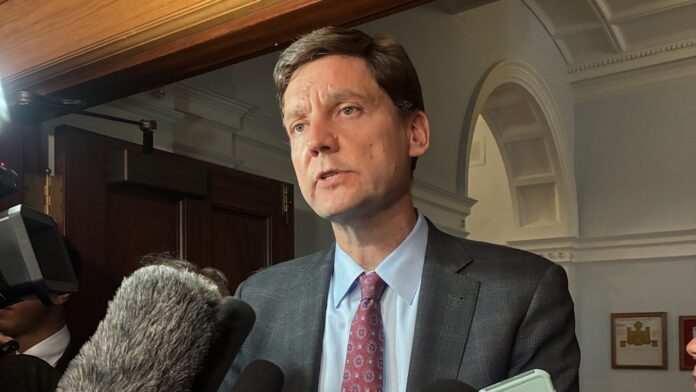

Premier David Eby expressed frustration Monday that the federal government’s latest tariff-relief measures do not include support for the softwood lumber industry.
“I don’t know what it’s going to take, really, to get the bureaucrats and ministers in Ottawa to recognize that softwood lumber employs more people in Canada than steel and auto parts combined,” he said.
Federal Industry Minister Mélanie Joly and Evan Solomon, the minister responsible for the Federal Economic Development Agency for Southern Ontario, announced $1.5 billion in support for several of Canada’s tariffed industries.
The package includes a new $1-billion Business Development Bank of Canada program that will be available to industries that manufacture and export products containing steel, aluminum or copper.
It comes after the U.S. in April increased tariffs on products made mostly of aluminum, steel and copper to up to 50 per cent.
Since last fall, total U.S. tariffs on Canadian softwood lumber have risen to around 45 per cent, on average. B.C.-based Canfor is operating with around 57 per cent duties and tariffs.
Eby said B.C.’s softwood industry is being “decimated” by the U.S. tariffs.
“It needs as much support as industries that are located closer to Ottawa,” he said.
He reiterated his concerns that European and Russian wood now has more access to the U.S. market than Canada.
Eby said the province will continue to push the federal government for more support.
“I keep searching for the correct way to get the attention of Ottawa,” he said. “We’re doing more media, we’re joining together with industry, we’re sharing information, and yet we still have days like today where softwood just doesn’t even make the list.”
Eby said he’s seeing some progress with Ottawa prioritizing softwood in trade negotiations with the U.S., but he wants the federal government to recognize the impacts the tariffs are having on the industry.
Ottawa says its support measures include $1.7 billion in loans and loan guarantees to address immediate operational needs of softwood lumber producers.
It has earmarked another $500 million for expanding sector transformation programs and measures to increase demand for forest products.
A “Buy Canadian Policy” also means federal procurement is prioritizing Canadian wood and engineered wood products, among other federal measures.
“The government will also continue to support other critical tariff-impacted industries that are key pillars of Canada’s economy, such as the softwood lumber and forestry sector,” said Monday’s announcement from Innovation, Science and Economic Development Canada.
B.C. Forests Minister Ravi Parmar said he is ready to work more with Ottawa on support for the forestry sector.
“I’m waiting for that phone call from Minister Joly anytime to be able to have those conversations,” he said.
Parmar said he’s also looking forward to seeing a recently completed report by a national task force that has been examining how to transform the forestry sector.
B.C. Conservative interim leader Trevor Halford said the province could be doing more to support the industry.
“We’ve got massive permitting backlogs, uncertainty about fibre supplies, and you can tell the frustration is mounting,” said Halford. “The results we’re getting are massive job losses and mill closures.”
A report released in April by the B.C. Council of Forest Industries estimates that there were about 10,000 job losses in the forest sector in 2025.
Be the first to know! Don’t miss out on breaking news and daily updates in your area. Sign up to MySouthOkanaganNews Alerts.