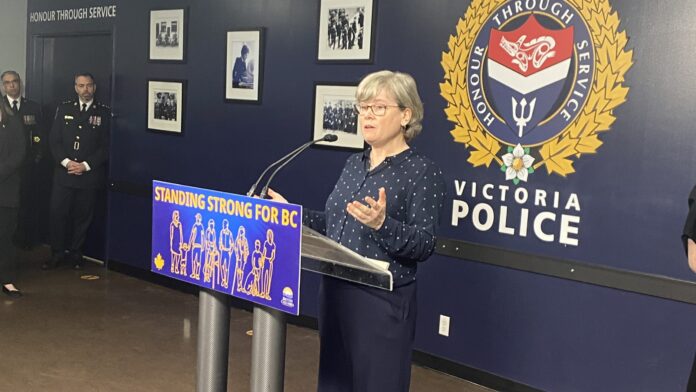

British Columbia says a new project will use artificial intelligence and robotics to detect toxic substances in drugs seized by police and trace where illicit drugs are coming from.
The province announced Friday it is providing $600,000 for the two-year “Track and Trace” pilot program.
It will see the RCMP and the Victoria, Surrey and Nelson police departments partner with the non-profit research institute Aidos Innovations and the University of British Columbia.
The province said researchers at a UBC lab will use robotics to analyze the molecules of certain drugs seized by police, looking for toxic additives and unique chemicals.
“The illicit drug supply is changing faster than our warning systems,” said Public Safety Minister Nina Krieger in a statement. “Track and Trace is an innovative technology that will allow early detection of emerging drug threats, provide clear insights into supply changes and risks, and improve co-ordination across jurisdictions in B.C.”
Matthew Roberts of Aidos Innovations said the process will be different from the main method for drug checking in B.C. using Fourier-transform infrared (FTIR) spectrometers, which are limited in which substances they can detect.
“We’re using an open analysis, so what that means is we can look at a broad spectrum of chemicals, catalysts and solvents, and it is that complex “fingerprint” that allows AI then to back-calculate what the recipe was to make that sample,” he said.
The province said the information will be added to a centralized dashboard that uses AI to help police identify patterns in the drug supply and target their source. It will include predictive mapping to track the movement of illicit drugs over time.
Roberts said it’s the first project of its kind in Canada, and possibly globally. He said bringing the digital and artificial intelligence analysis into the project makes it unique.
“Each individual technology has been used multiple times elsewhere. We believe we’re the first to bring those technologies together,” he said.
The data from the pilot would not initially be used in criminal investigations, but Victoria Police Chief Fiona Wilson said that she hopes that eventually the information would be used for criminal prosecution.
“We’re not there yet. That’s the reason why we’re engaged in this pilot project because it’s a first step towards that goal,” said Wilson.
Health Minister Josie Osborne said it could be a tool to help address the toxic drug crisis.
“From a health perspective, knowing that there may be a way to get information faster to paramedics, to clinicians, to emergency rooms and out into the public about the state of the toxic drug supply literally can save lives,” said Osborne.
This week, B.C. marked the 10-year anniversary of the province declaring a public health emergency over the toxic drug crisis. Provincial data shows at least 18,000 people have died due to toxic substances since 2016.