
One British Columbia project is on the federal government’s list of priority projects for new infrastructure funding.
The federal Liberals released details Tuesday of how the government plans to spend $51 billion on local infrastructure.
The first tranche of 13 projects under the new Build Communities Strong Fund (BCSF) includes the new zero-carbon Marpole Community Centre in Vancouver.
The list also includes wastewater projects in Nova Scotia and PEI, street redesigns in Laval, Quebec and infrastructure to support future housing development in Nunavut.
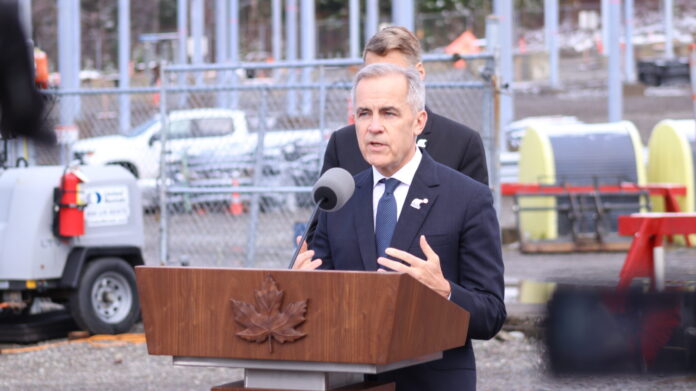
Prime Minister Mark Carney said the program will start with a $64 million investment into a new community centre and park in Brampton, Ontario.
The projects will be funded out of a $6 billion “direct delivery” stream that provides funding for large building retrofits, climate adaptation, and community infrastructure. The federal government said the projects will need to consider private sector investment, including through the Canada Infrastructure Bank.
The funding program was previously announced as part of the federal government’s Budget 2025. It’s expected to deliver $51 billion in infrastructure funding across Canada over the next 10 years, and $3 billion per year in ongoing funding.
Last year’s budget highlighted some other B.C. projects that would receive funding through the direct delivery stream, including a new Filipino community and cultural centre in Vancouver, White Rock Pier in White Rock, Newton Athletic Park in Surrey, and Royal Athletic Park in Victoria.
Provinces and territories will get a total of $17.2 billion for infrastructure related to housing, post-secondary education and health care. B.C. would receive about $2.2 billion, including more than $600 million specifically for health care infrastructure.
To receive that funding, provinces must sign bilateral agreements with the federal government and agree to cost-match the federal funding. Provinces are also being asked to reduce development charges on multi-unit housing, and avoid new taxes or fees that could hinder housing supply.
The province has said it’s in discussions with the federal government about the funding. A spokesperson for B.C.’s Ministry of Housing and Municipal Affairs said it’s seeking a “made-in-B.C.” program, noting that many local governments rely on development cost charges.
Many municipalities use one-time fees from new developments to help fund infrastructure needed to support growth, such as roads, water, sewer, waste collection and parks.
More than half of the total funding is previously existing funding that was doled out through the Canada Community-Building Fund. It’s now set to be delivered through a rebranded “community stream” of the BCSF. The program will continue to provide $2.5 billion annually to provinces and territories, who in turn distribute the funds to communities to support local projects like roads, bridges, public transit and more.
British Columbia is expected to receive more than $1.6 billion through the community stream between 2024 and 2029, with future allocation to be determined based on census data.