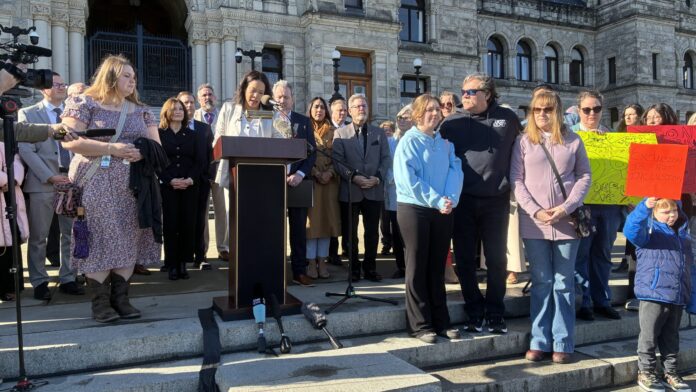

The B.C. Conservatives and some families of children with autism gathered at the legislature Thursday to call on the province to reconsider recent changes to disability funding.
They voiced concerns that the new programs could reduce access to needed supports and funding for children with autism.
The B.C. government announced in February it would replace the current autism funding program with a new benefits model.
The province said the new benefit will provide families of children with significant disabilities with $6,500 or $17,000 per year, based on need. The benefit will be phased in over 2026 and 2027.
It also said $80 million will be used to expand community programs, such as behavioural therapy and mental health supports.
The previous autism funding program, created in 2002, offers up to $22,000 annually for children aged three to five, and up to $6,000 for children and youth aged six to 18.
The broader funding approach under the new program has been praised by families of children with disabilities such as fetal alcohol spectrum disorder and Down syndrome, who have long been ineligible for funding in B.C.
However, the Ministry of Children and Family Development (MCFD) has said some families of autistic children with lower needs who exceed a $200,000 household income threshold may see their direct funding reduced under the new program.
Children and family development critic Reann Gasper said Thursday during a rally in front of the legislature that more than 10,000 children would be affected by the changes.
“We do not want to build a better system by pulling support away from children who are already receiving it,” said Gasper.
Jennifer Marcell said her family travelled four hours from their home in the small community of Sayward to attend the legislature gathering. She said her four children with autism were receiving funding under the previous model.
She said that under the new program, her children will no longer be able to access at-home therapy, and the family will instead need to drive two hours to see a therapist.
“With four kids, it’s very hard to manage,” said Marcell.
The province has shared example profiles illustrating how funding might change for families. In one example, a child dubbed “Sam,” who has low-needs autism and a household income of $165,000, would see their funding reduced from $78,000 over their childhood to $41,600. The province said the child would also have priority access to expanded community programs, such as employment-readiness groups and speech-language therapy.
MCFD Minister Jodie Wickens said the province is taking a more “tailored approach” to disability funding, based on advice from experts.
“We’re making sure that funding is based on functional need, not a singular diagnosis alone,” said Wickens.
“When you change a system … that is going to be hard for some families,” she said.
Provincial data show an estimated 107,000 children and youth in B.C. have support needs, not including those with milder needs such as learning disabilities.