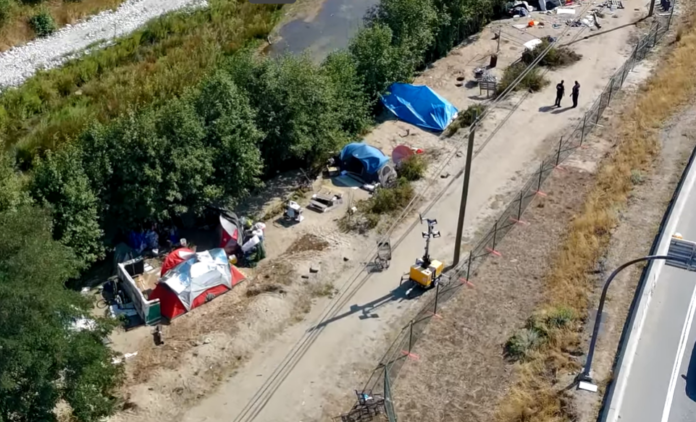

A controversial British Columbia government court injunction aimed at dismantling the Fairview encampment near Highway 97 in Penticton is officially on hold.
Originally scheduled to force the removal of roughly 23 unhoused residents, the case was indefinitely adjourned on March 13 after a mutual agreement.
The postponement highlights growing legal and moral tension between provincial public safety enforcement and the constitutional rights of vulnerable people living through a severe housing shortage.
The Ministry of Transportation and Transit initially sought the injunction to remove residents and their structures from provincial land. The ministry cited trespassing and serious public safety hazards, including allegations campers interfered with a nearby traffic light junction box to access power.
Encampment residents disputed those claims in a legal response.
They denied tampering with the electrical box and outlined steps taken to improve safety, including transitioning from propane to electricity and working with the local fire department.
Margot Young, a professor at the Allard School of Law at the University of British Columbia, said establishing severe safety risks is crucial for the government, as legal precedent often favors unhoused people when shelter is scarce.
“And courts have been really reluctant to allow injunctions of that sort if they’re basically evicting people into shelterless circumstances,” Young told Gary on the Early Edition.
Without strong evidence of unmitigated safety threats, the right to basic shelter often prevails.
“Constitutional rights are really preeminent. And they do trump other kinds of non-constitutional interests.”
Complicating the province’s legal bid is Penticton’s distinct lack of alternative housing options.
Recently, city council rejected a proposed 50-unit tiny home project.
In cities such as Kelowna, similar transitional structures successfully provide a stepping stone toward stable housing for those sleeping rough.
Under a landmark B.C. Court of Appeal ruling, unhoused individuals have the legal right to shelter themselves on public land overnight if adequate shelter beds are unavailable.
By turning down the tiny home development, the region weakened the argument that displaced campers have somewhere safe to go.
“And so the failure to actually put into motion the building of those fifty other shelter spaces tells against the fact that there are adequate other shelter beds,” Young said.
The adjournment leaves the Fairview encampment unresolved but signals a significant hurdle for future provincial and municipal eviction efforts.
Governments across Canada are grappling with how to manage public spaces and safety concerns without violating basic rights.
The standoff in Penticton represents a much larger national conversation regarding how we treat our most vulnerable populations, Young said.
“Encampments are manifestations of the housing crisis and the response to simply evict residents of encampments into who knows what other forms of situation as a common response at both the municipal and now the provincial level, because these are provincial lands is, I think, quite inadequate,” Young said.