
Moody’s Ratings has again downgraded British Columbia’s credit rating, citing the province’s growing operating and capital spending, large structural deficits and rising debt.
The agency downgraded B.C.’s long-term issuer and senior unsecured debt rating to Aa2 from Aa1, one notch lower and two notches below the top Aaa rating. Moody’s maintained a negative outlook.
The rating reflects Moody’s opinion of the province’s ability to repay its debts. A lower rating can raise borrowing costs and reduce financial flexibility.
It is the second time Moody’s has downgraded the province in the past two years.
“While multiyear planning and transparent reporting remain credit strengths, the latest budget confirms a deterioration in long-term fiscal management relative to our previous assessment,” Moody’s said.
Moody’s noted the government’s 2026 budget projects a $13.3-billion deficit in 2026-27, followed by deficits of $12.2 billion and $11.4 billion in the next two fiscal years, with no clear timeline for a return to balance.
It said the province continues to rely heavily on borrowing to fund operating deficits and help finance its capital plan. Budget 2026 says taxpayer-supported capital spending will total $53 billion over three years.
Trade uncertainty growing risk
The agency also highlighted risks tied to global and U.S. trade uncertainty. At the same time, Moody’s said B.C.’s economy remains resilient and diverse, with limited reliance on any one sector.
“The province maintains extremely strong access to domestic and international capital markets including a broad range of institutional investors,” it said.
Other credit agencies have also downgraded or lowered their view of B.C.’s creditworthiness over the past year. S&P Global Ratings downgraded the province to A+ from AA- in April 2025 and maintained a negative outlook. Morningstar DBRS said after the 2026 budget that the province’s deficit and debt path is materially reducing flexibility at its current rating level.
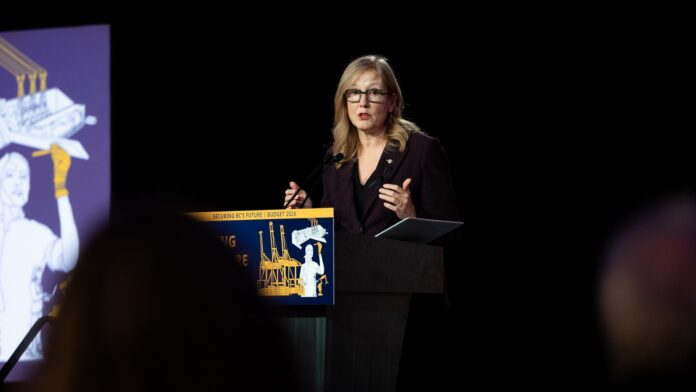
“We’re building B.C.’s position as the economic engine of a stronger and more self-reliant Canada, moving forward with major projects that put people to work and support strong communities,” Finance Minister Brenda Bailey said in an emailed statement. “As it is challenging times for everyone across Canada, and we’re taking disciplined steps to ensure B.C.’s fiscal sustainability for the long term, while protecting important services people rely on, and diversifying our trading relationships.”
The Finance Ministry said B.C. remains one of the highest-rated Canadian provinces, with strong access to global capital markets.
The B.C. Conservatives said the downgrade shows the government needs to reconsider its latest budget.
“The government needs to take this seriously, go back to the drawing board, and table a budget that will restore confidence in world financial markets. This budget is putting B.C.’s financial future at risk,” interim Conservative leader Trevor Halford said.