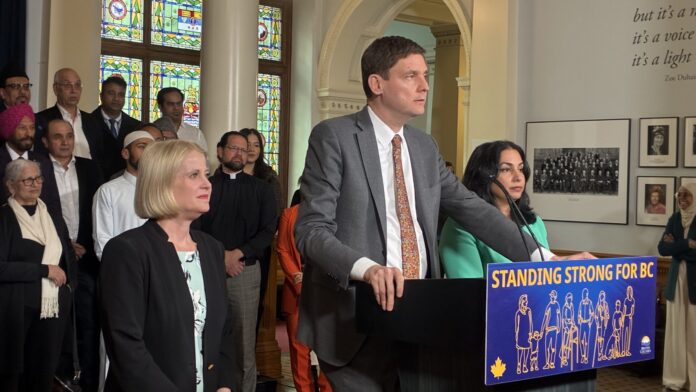
British Columbia’s NDP government tabled legislation Monday to extend restrictions on protests and other “disruptive behaviour” near schools and expand the rules to public places of worship.
The province passed legislation in May 2024 limiting protests and other disruptions within 20 metres of all K-12 schools. The rules apply from 7 a.m. to 6 p.m. and during extracurricular school activities.
The legislation came in response to protests at schools against the province’s education initiatives that provide resources on sexual orientation and gender identity.
The law contains a sunset clause that is set to expire on July 1, 2026. Bill 12, the Safe Access to Schools Amendment Act, would extend it to 2028. Attorney General Niki Sharma said the sunset clause allows the legislature to reassess the need for the law over time.
Education Minister Lisa Beare said the number of “disruptions” near schools has decreased since the legislation was introduced.
“But unfortunately, they have not been eliminated, which is why we’re taking further action,” said Beare.
Bill 13, the Safe Access to Places of Public Worship Act, would create similar “access zones” around mosques, synagogues, temples, churches and other places of worship.
The government said it comes in response to rising cases of vandalism and other harmful behaviour targeting religious buildings.
“We need to make sure that people are able to attend their place of worship, and feel comfortable in doing so, and feel protected in doing so,” said Premier David Eby.
“The core here is protecting activities that are at the heart of what it means to be in a free and democratic society, while minimally impairing the rights of people to protest, if that is what they choose to do,” said Eby.
The bill would allow public places of worship to post signage indicating 20-metre zones where police could arrest or issue tickets to individuals found to be impeding access or being disruptive to worshippers. Prohibited behaviours would include preventing people from accessing a place of worship, disrupting activities like prayers or meetings, intimidating or threatening people, and trying to persuade people not to visit a place of worship.
Sharma said the law is intended as a deterrent, rather than an opportunity to slap people with fines.
“Having those legal protections in place gives authorities better tools to control behaviour on the ground. So instead of a fine-driven process, it’s a legal-centred process related to us controlling behaviours that are set out there,” said Sharma.
The legislation would also allow a place of worship, the attorney general and others to apply for a Supreme Court injunction to remove a protest.
The province said individuals would still be allowed to peacefully gather outside places of worship as long as their activities don’t amount to intimidation or interfere with access.
Bill 13 also includes a sunset clause requiring it to be reassessed in 2030.
The province said the bill is modelled after previous legislation that created similar zones around hospitals, schools and other facilities during the COVID-19 pandemic. Current laws also restrict protests and harassing activities near abortion providers.
The B.C. Civil Liberties Association was not immediately available to comment on the story for Vista News, but pointed to their previous statement raising concerns about a 2025 Toronto bylaw that limits demonstrations outside of places of worship, schools, and child care centres.
“Places of worship, schools, or childcare centres, are unfortunately not immune from engaging in behaviour that may spark legitimate political protest,” said the BCCLA statement. “The actual context, content, and conduct at a specific protest are essential for a legal analysis of whether any offences have occurred warranting state intervention.”
Data from Statistics Canada show the number of police-reported hate crimes targeting religion in B.C. has broadly trended upward, peaking in 2021.
In 2024, there were 125 such reports in the province, compared to 44 in 2014.
Jewish people were by far the most frequently targeted between 2020 and 2024, followed by Muslims and Catholics.