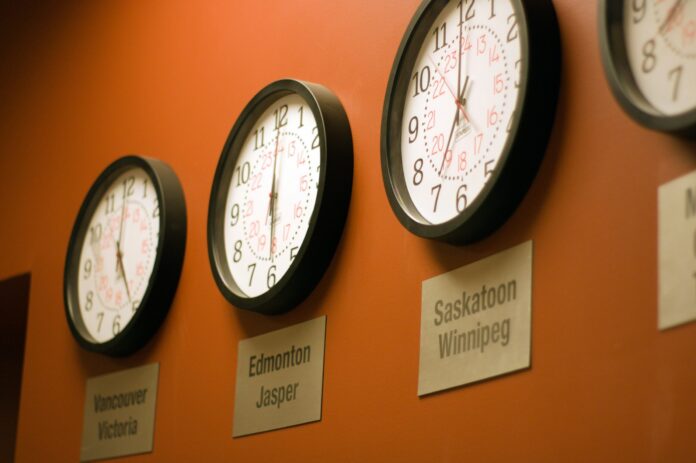

Clocks are set to “spring forward” at 2 a.m. Sunday — but it could be the last time most British Columbians lose an hour of sleep.
The B.C. government announced on Monday it’s doing away with twice-yearly time changes and adopting permanent Daylight Saving Time (DST). It said the purpose of the change is to improve people’s overall health, reduce disruptions for families, simplify scheduling and provide an extra hour of evening light during the winter months.
There will be no turning the clocks back one hour this fall, leading to darker mornings in the winter months but an extra hour of daylight in the evenings. Parts of B.C. already observe Mountain Standard Time year-round, which will align with the move to permanent DST.
Ralph Mistlberger, a psychology professor at Simon Fraser University who researches sleep and circadian rhythms, said he’s doubtful about the claims that permanent DST will be better for people’s health.
Mistlberger said he’s in favour of eliminating the twice-yearly time changes, but said choosing permanent DST is counter to the recommendations of global sleep and chronobiology societies, which overwhelmingly prefer year-round Standard Time.
Mistlberger said the darker mornings in the winter months are going to impact young people and people who are night owls the most. He said our brains and most body tissues have what he describes as a 24-hour circadian clock that is synchronized by natural light.
“The morning light is what prevents the ‘clock’ from wanting to drift to a later time. Evening light hastens the drift,” said Mistlberger. “So if you’re getting less morning light, then effectively you become more of a night owl.”
He said for children and teens who need to get up early in the morning for school, those sleep impacts can lead to poorer performance in class, mood changes and depression, and possibly affect their long-term development. He said moving school start-times later in the morning would help offset some of the negative impacts on young people.
For adults, he said it can not only affect job performance, but potentially also impact metabolic and cardiovascular health.
“Most people will like the idea of having more light in the evening. Well who doesn’t? It’s nice to have that, but you’re doing it at the cost of something,” said Mistlberger. “It may have some benefits for some things, but on balance it’s not the best at the social level.”
Mistlberger recommends those who need to start their day in the dark get a specialized light that is designed to treat Seasonal Affective Disorder, known as a SAD lamp.
“Those are really good for giving you doses of biologically significant light,” he said. “You want sort of a white-bluish light, and you want it as bright as you can get.”
B.C. first introduced legislation in 2019 that paved the way for the province to adopt permanent DST. A survey that year found 93 per cent of B.C. residents supported permanent DST, with three-quarters of those preferring year-round DST citing health and wellness concerns as a reason for their support.