
The Musqueam Indian Band and federal officials say a recent agreement related to the First Nation’s traditional territories in the Vancouver area does not affect private property rights.
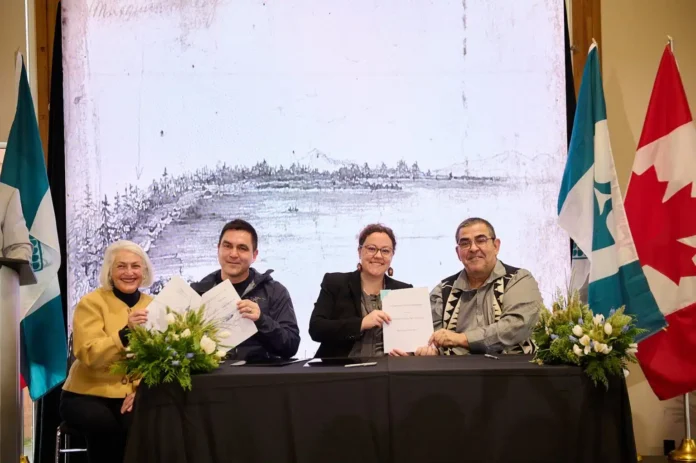
The federal government and Musqueam announced the three-part Musqueam Rights Recognition Agreements on Feb. 20.
The federal government said one agreement recognizes that Musqueam has Aboriginal rights, including title, within its traditional territory and establishes a framework for the incremental implementation of rights and nation-to-nation relations with Canada.
Musqueam’s traditional territory centres around the mouth of the Fraser River and what is now the City of Vancouver and surrounding areas.
A marine management agreement also establishes collaborative working groups for shared decision-making around waters and resources within Musqueam territory. Another fisheries agreement is described as supporting Musqueam’s and Canada’s shared decision-making role in collaborative fisheries management within Musqueam territory. It also provides funding, including for access, vessels and gear.
While they were announced last month, the initial press release didn’t include the full text of those final agreements. The federal government sent the document to media outlets Monday and posted it online when after increased media scrutiny.

The B.C. Conservatives raised concerns about transparency from the provincial government surrounding the deal.
Premier David Eby said Monday his government had not been briefed by the federal government about the content of the agreement. However, his office confirmed Eby attended the signing ceremony on Feb. 20, saying he attended in his capacity as MLA for Vancouver–Point Grey.
A spokesperson for the federal Crown-Indigenous Relations Ministry told Vista News that the B.C. government was briefed several times in the years leading up the agreement, including one week before the signing.
The B.C. Conservatives grilled Eby on the matter Wednesday in the legislature. Eby clarified that a staffer with the B.C. public service was briefed on the agreements, but that briefing was not passed on to the Premier’s Office or other ministers.
“If I’m being generous, I imagine they assumed that sitting down with the Musqueam to talk about title was not controversial, was not something that was worth bringing up to those levels,” said Eby.
Conservative interim leader Trevor Halford said finds it hard to believe the premier was not aware of the contents of the agreement prior to Monday.
“At the end of the day, transparency is important,” Halford told reporters. “It shows that we have a premier that is choosing not to be honest with the public and I am very troubled by that.”

Reports about the agreement reignited concerns about whether private property rights could be affected, following a B.C. Supreme Court decision last August in favour of the Cowichan Nation’s title claims over an area of Richmond.
The B.C. government and the Musqueam are among those appealing of the decision.
“In light of the recent Cowichan decision and the government’s own statements about reviewing DRIPA, the silence from this NDP government is unacceptable,” said Scott McInnis, MLA for Columbia River–Revelstoke and Critic for Indigenous Relations, in a statement Monday. “In absence of clear communication, British Columbians are left to draw their own conclusions about how this will impact them.”
Federal Minister of Crown-Indigenous Relations, Rebecca Alty said in a statement posted to social media the agreements do not affect private property.
“Under this agreement, Canada and Musqueam have created a path forward to negotiate Musqueam’s rights and title, rather than pursuing litigation in the courts,” said Alty.
“This more collaborative approach prevents uncertainty and allows us to come to an agreement that respects the rights of Indigenous People, protects existing private property rights, and is in the best interests of British Columbians and Indigenous People,” she said.
Musqueam also issued a statement Monday reiterating the agreements do not relate to land ownership and that there are absolutely no impacts to fee simple lands or private property.
They quoted a December statement from Chief Wayne Sparrow:
“Musqueam is not coming for anyone’s private property. Our approach to traditional unceded territory is one of partnership and relationship with our neighbours, not trying to take away our neighbours’ private property,” he said.
Wendy Grant-John, lead negotiator for the Musqueam Indian Band, said the agreements come after more than 10 years of discussions, collaboration and negotiation.
Wade Grant, MP for Vancouver Quadra and a member of the Musqueam Nation, also stressed in a statement on Wednesday the agreements have no impact on private property rights.
“The vast majority of the Province of British Columbia was never settled via treaties between First Nations and the Crown. Agreements like these provide greater clarity and stability for everyone,” said Grant.
Tim Dickson, a lawyer with JFK Law in Vancouver who specializes in Aboriginal law, said a key part of the agreement recognizes that the Musqueam have Aboriginal title and rights within parts of their traditional territory.
“That’s a very common statement to make in agreements with Indigenous nations,” said Dickson.
“All this agreement does is set the table for more specific negotiations, that may or may not be successful,” he said.
“There has been a lot of overreaction to the Cowichan Tribes decision in terms of fear for the validity of individual homeowners fee simple titles,” said Dickson. “Both Indigenous nations and the courts have been very careful not to undermine those rights to date.”
“I think we should all be supporting the process of reconciliation, which is done through negotiated agreements like these,” said Dickson.