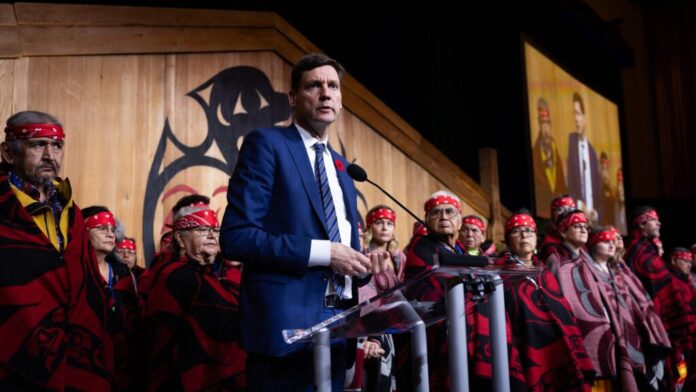

Premier David Eby slammed recent court decisions in British Columbia related to Indigenous rights and title, in remarks at a B.C. Chamber of Commerce event on Wednesday.
He pointed to the August ruling by the B.C. Supreme Court on the Cowichan Nation’s title rights in an area of Richmond, as well as a B.C. Court of Appeal ruling last week, calling them “overreaching” and “unhelpful.”
In an Aug. 7 ruling, the B.C. Supreme Court found the Cowichan have Aboriginal title to the lands at their former village site in Richmond and the right to fish the south arm of the Fraser River.
The court ruled the majority of titles and interests in the lands held by Canada and Richmond are defective and invalid, and gave them 18-months to work out a solution with the First Nation.
Eby has said the province is appealing the decision and is working on a stay of its implementation.
“The court began the case assuring all parties that nothing would be decided in the case that impacted the interest of landowners in the title area, and then when the decision was issued, did the exact opposite,” Eby told the BC Chamber Premier & Cabinet Luncheon.
Former B.C. Conservative leader John Rustad called for all negotiations with First Nations to be put on hold, and for the case to be put to the Supreme Court of Canada for a reference question.
First Nations leaders have said the case is not about seizing private property, and politicians are unfairly scapegoating First Nations.
Last Friday, the B.C. Court of Appeal ruled that the province’s mineral tenure system is not compatible with B.C.’s Indigenous right legislation. It said that courts can decide whether a law is inconsistent with the United Nations Declaration on the Rights of Indigenous Peoples (UNDRIP), opening the door to more lawsuits against the province.
Eby said the cases are creating uncertainty and jeopardizing public support for reconciliation efforts with First Nations.
“There have to be strong boundaries,” said Eby. He said that means any reconciliation work must respect private property, and that British Columbians, not judges, should decide the path forward.
Eby said B.C.’s Attorney General Niki Sharma is leading work to amend the Interpretation Act and Declaration on the Rights of Indigenous People’s Act (DRIPA) to reflect what he said was the original intent of the legislation. He said his government plans to introduce those amendments in the spring.
Eby earlier this week rejected calls from the B.C. Conservatives to recall the legislature in order to repeal DRIPA.
Regional Chief Terry Teegee told Vista News that Eby is mischaracterizing the Declaration Act.
“This [B.C. Court of Appeals ruling] is, I would say, a legal correction, rather than confusion,” said Teegee, saying it reinforces the original intent of DRIPA.
“You can’t simply say you don’t like a judgement, so you’re going to change the rules,” he said, adding that efforts to amend the law would be “a slap in the face” to First Nations after the commitment made when the legislation was introduced in 2019.
The post Eby blasts B.C. court rulings on Indigenous rights and title as overreaching appeared first on AM 1150.