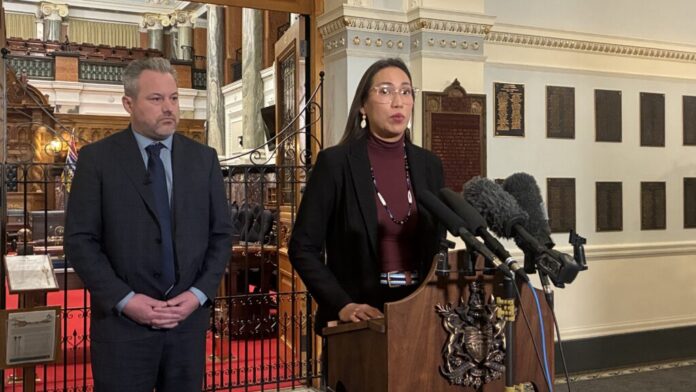

Premier David Eby said his government will consider amending British Columbia’s Indigenous rights legislation, known as the Declaration on the Rights of Indigenous Peoples Act (DRIPA).
It comes after the B.C. Court of Appeal said in a ruling Friday that the province’s mineral tenure system is not compatible with the legislation, and said that courts can decide whether a law is inconsistent with the United Nations Declaration on the Rights of Indigenous Peoples (UNDRIP).
The province adopted the Declaration Ace in 2019, establishing UNDRIP as a framework for reconciliation.
The Gitxaała and Ehattesaht nations launched a partial appeal of a 2023 B.C. Supreme Court decision related to the province’s “free entry” mineral tenure system. The Gitxaała Nation said Friday the decision affirms that First Nations can take the province to court if it fails to meet its obligations under DRIPA.
Speaking at the First Nations Clean Energy Summit in Vancouver on Monday, Eby said DRIPA needs to be amended, but he rejected the idea of repealing it entirely.
Eby said it will take some time to review the court’s decision and consult with First Nations and other stakeholders on amendments to DRIPA.
He said the province may decide to take the ruling to the Supreme Court of Canada for a decision.
The B.C. Conservatives have long called for DRIPA to be repealed, and say the legislature should be recalled in order to do so this week.
The fall session of the legislature wrapped up on Dec. 3. The spring session begins in February.
Conservative House Leader Áʼa꞉líya Warbus said Monday that just amending DRIPA won’t be enough to provide certainty to British Columbians concerned about how their private property rights are affected by First Nations title cases.
She said Section 35 of Canada’s Constitution Act already recognizes and affirms Indigenous rights.
Warbus said using UNDRIP as a “guiding document” would allow for more flexibility to address the needs of Indigenous communities. “[DRIPA] really put the cart before the horse in terms of dealing with the many distinct Nations that we have in British Columbia,” she said.
Gitxaała Chief Councillor Linda Innes called Friday’s ruling an “exciting victory.”
A lower court had previously found B.C.’s online system allowing automatic registration of mineral claims without First Nations’ consultation violated the Constitution.
The nations had also argued that the system violated DRIPA, but the lower court ruling found DRIPA was not legally enforceable by a court.
B.C. Court of Appeal Justices Gail Dickson and Nitya Iyer overturned that finding, saying “the judge erred in adopting an unduly narrow approach to the legal effect of the Declaration Act and UNDRIP.”
Justice W. Paul Riley wrote a dissenting opinion, saying DRIPA’s implementation should happen through government–Indigenous collaboration, not litigation.
When DRIPA was tabled in 2019, B.C.’s then-minister of Indigenous Relations and Reconciliation Scott Fraser said the act would be an interpretive tool and would have no legal force.
“When we set up the Declaration of the Rights of the Indigenous People Act, we were very clear that this wasn’t the territory of the courts.” said Eby Monday. “We need to make amendments to make the original intent clear, and we will do that.”
Veronica Martisius is staff litigation counsel at the B.C. Civil Liberties Association, which was an intervener in the appeals court case. She says the ruling opens the door for First Nations to take the province to court when laws are not consistent with UNDRIP.
“We think that the Court of Appeal was correct in its decision around justiciability because it’s an important accountability mechanism that First Nations and Indigenous peoples in B.C. can look to to hold the government accountable to its promise [under DRIPA],” said Martisius.
She said she doesn’t believe amending DRIPA would provide further clarity, “unless it is truly their intention to dictate how reconciliation happens on their terms,” she said.
The post B.C. weighing amendments to DRIPA following landmark appeal court decision appeared first on AM 1150.