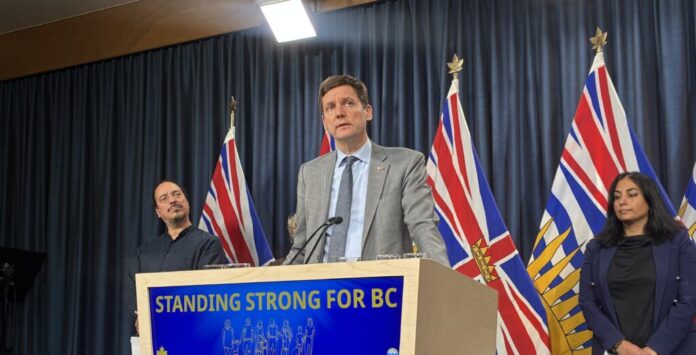

Premier David Eby said he spoke to Prime Minister Mark Carney by phone Monday morning, amid reports that Ottawa is close to inking a deal with Alberta that includes steps toward a new pipeline to British Columbia’s north coast.
Premier Danielle Smith said last week the two governments were “very close” to a deal. Smith said the talks have included ways of getting Alberta bitumen to new markets, including a new pipeline, and easing the so-called “nine bad laws” that she said are barriers to oil and gas investment.
Eby said Carney told him Monday morning that a memorandum of understanding (MOU) with Alberta had not been finalized.
Hours later, CBC reported a deal has been reached and a formal announcement on the agreement is expected Thursday.
Eby has repeatedly dismissed Alberta’s pipeline proposal as unrealistic, too costly and potentially dangerous for the economy.
He said he outlined B.C.’s position to Carney, including that any new project must have the support and consent of First Nations.
Eby reiterated that no private backer has come forward to support a new pipeline project — and he doubted any would.
“There is not a world in which, with the current price of oil, a private company is going to step up and pay for this pipeline to the north,” Eby told reporters on Monday.
He said he made it clear to Carney that taxpayers shouldn’t be on the hook for a new pipeline. Eby said he suggested there should be a prohibition or a cap on taxpayer dollars invested in the project — “Or If it is going to be taxpayer funded, then British Columbia get access to a $50 billion federally funded project as well,” said Eby.
He said he also spoke to Carney about keeping the oil tanker ban on B.C.’s north coast in place.
A voluntary tanker exclusion zone had been in place in the region since 1985. The federal government formalized the moratorium in 2019, prohibiting oil tankers carrying more than 12,500 metric tonnes of oil. It covers the area from the Alaska border, down to the point on British Columbia’s mainland across from the northern tip of Vancouver Island, including Haida Gwaii.
Smith has said the tanker ban is one of several barriers to investment in a new pipeline. Dozens of major energy companies have also called on Ottawa to repeal the ban.
Eby said Monday the ban on oil tankers in the region has been around for decades because it’s an “incredibly precarious” shipping route.
“A heavy oil spill will decimate a $1.7 billion industry of fisheries and tourism and a way of life for people in the northwest who have been living that way of life for a millennia,” he said.
Eby and Coastal First Nations signed a joint declaration earlier this month calling on the federal government to uphold the oil tanker ban.
Eby said Carney listened to his recommendations carefully but made no commitments about what will be included in the agreement with Alberta.
B.C. Energy Minister Adrian Dix noted it’s still not clear what the MOU will contain, so it’s hard to comment on it. He said the pipeline project still lacks any real plan, proponent or budget.
Dix said last week he would rather see Alberta and the federal government focus on expanding the capacity of the existing Trans Mountain pipeline.
B.C. Conservative Leader John Rustad said Monday afternoon he is glad to see the federal government prioritize a new pipeline. He said the Eby government is standing in the way of a “nation-building” project.
Smith said in October her government would submit a formal application to the federal Major Projects Office (MPO) by next spring to fast-track a new pipeline project. She said the application would be supported by $14 million from her government. The advisory group includes energy companies South Bow, Enbridge and Trans Mountain.
The post Eby raises red flags as Ottawa, Alberta move toward pipeline agreement appeared first on AM 1150.