
British Columbia leaders are welcoming a range of new measures from the federal government intended to support Canada’s lumber industry, but say the new supports for steel fall short of what the province needs.
Prime Minister Mark Carney announced Wednesday that Canada is moving to further limit foreign steel imports to allow domestic producers better access to the Canadian market.
Carney said his government will also work with railway companies to make it cheaper to transport Canadian steel and lumber between provinces by cutting freight rates in half, beginning next spring.
For the lumber industry, an additional $500 million will go to a loan guarantee program for softwood producers through the Business Development Bank of Canada.
The funding comes on top of the $700 million in loan guarantees for the lumber sector Carney announced during a visit to Kelowna in August.
Around $500 million will also be earmarked for loans to support lumber firms facing liquidity pressures due to tariffs.
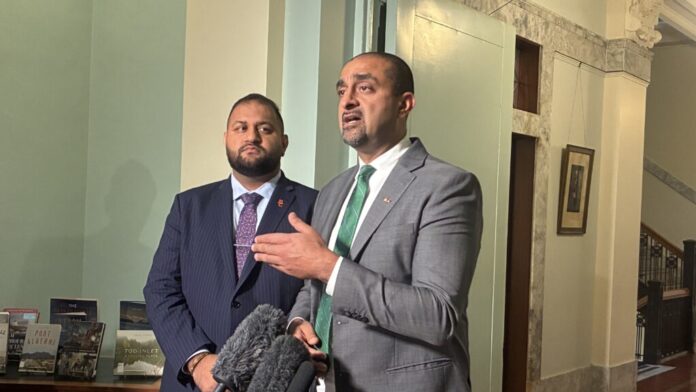
B.C. Forests Minister Ravi Parmar said the changes are a “good start,” and show that Ottawa is listening to many of the province’s concerns.
He said the reduction of freight costs is important for B.C. to be able to ship more lumber across Canada, particularly to Ontario.
Parmar said he hopes to see B.C. companies get their “fair share” of the loan guarantees, which he said should amount to about half the funds.
“We need to see direct investments from the federal government to help ensure we’re diversifying the sector and creating more value-added products, and I’ve certainly been given assurances from the federal government that this is just the start of more investments they’ll be making in forestry,” Parmar told reporters Wednesday.
Softwood lumber producers say more help is urgently needed as the industry faces U.S. tariffs as high as 45 per cent.
Federal and provincial officials attended a forestry summit in Vancouver earlier this month, where they announced a joint task force to determine how to support the hard-hit forestry sector.
Carney on Wednesday announced a second task force to seek input on how the forestry sector can stay competitive over the long term.
He also said Build Canada Homes, the new federal agency tasked with boosting the affordable housing supply, will prioritize shovel-ready projects that use Canadian wood.
The B.C. Council of Forest Industries (COFI) said it’s important that the operators can access the funding and supports quickly.
“While application processes are open, companies are still waiting too long for decisions,” said COFI President and CEO Kim Haakstad.
She welcomed the federal government’s announcement Wednesday that it will also establish a single window to applications to help companies navigate support programs.
“While these measures are positive, the long-term solution remains a durable, negotiated softwood lumber agreement that gives workers and companies the confidence and clarity they need to invest, compete, and plan for the future,” said Haakstad.
B.C. Conservative Leader John Rustad said he’s happy to see some support for the province’s struggling forest sector.
He said Canada needs leverage to get the U.S. to come to the table and negotiate a trade deal on softwood. Rustad has previously proposed putting a levy on U.S. shipments of thermal coal at B.C. ports.
Jobs and Economic Growth Minister Ravi Kahlon also welcomed many of the new measures, but said he has “serious concerns around steel.”
“The federal government appears to be making a policy in Ontario for Ontario around steel and not reflecting the challenges that are faced in British Columbia,” said Kahlon.
He said it currently costs about $200 per tonne to ship steel from Ontario to B.C., compared to about $35 per tonne for steel coming from Asia.
The federal government plans to tighten tariff rate quota levels for steel products from countries that don’t have a free trade agreement with Canada, from 50 per cent of 2024 levels to 20 per cent.
Tariff rate quotas allow a certain amount of product to be imported at a lower tariff, with a higher duty applied to imports exceeding that allowance.
The changes also include a reduced tariff rate quota for free-trade partners aside from the U.S. and Mexico, and a global 25 per cent tariff on steel-derivative products, ranging from wind towers to wires.
The federal government estimates the changes will create about $1 billion in new domestic demand for Canadian steel.
The post B.C. leaders welcome new lumber supports, criticize steel measures appeared first on AM 1150.