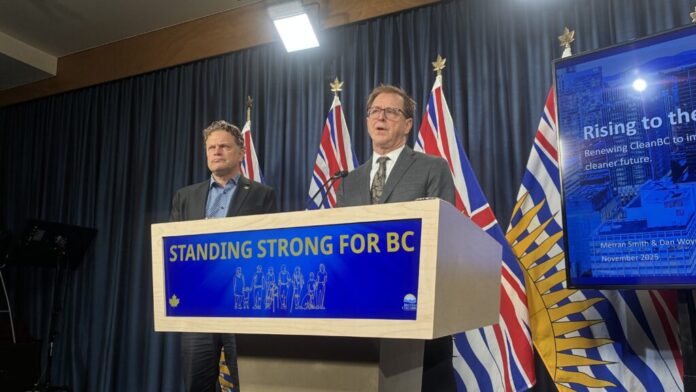

An independent review of British Columbia’s climate action plan says the province is mostly on the right track, though some sectors are not expected to meet their 2030 emissions targets.
The reviewers tasked with reviewing the Clean BC program said Wednesday there’s no need to go back to the drawing table entirely, but there’s a need to “recalibrate” some of the targets going forward.
CleanBC was launched in 2018 with the goal of achieving net-zero emissions by 2050.
The B.C. NDP government agreed to a review of Clean BC programs one year earlier than scheduled, as part of their co-operation agreement with the B.C. Greens.
The province announced the independent review in May, acknowledging B.C. is not on track to meet its 2025 and 2030 targets. It said the province’s rapidly growing population required a reassessment to ensure CleanBC is effectively reducing emissions.
The review was led by Merran Smith, president of the business and labour alliance New Economy Canada, and Dan Woynillowicz, a policy analyst and strategist.
They said CleanBC’s policies are measurably reducing per capita climate emissions, but the plan is “not yet reaching its full potential.”
The report said the government aimed too high when it initially formed the Clean BC plan. “Achieving its 2030 target would have required a near-seamless execution of policies and programs, ideal economic conditions, and complete consensus between stakeholders. And even then, it would have needed a healthy dose of good luck,” Smith and Woynillowicz said in an executive summary of the report.
They said modelling points to the province achieving just half of its 2030 targets for emissions reduction.
The report makes dozens of recommendations across seven key areas, most of them focused on how to shift the province further toward electrification.
That includes setting more achievable zero-emissions vehicle sales targets for 2030. The province already announced last week it will be backing off target 100 per cent sales by 2035.
At the same time, the authors said B.C.’s planned rapid expansion of the LNG sector risks setting the province back on its climate targets.
They said increased gas production and new LNG export projects add significant new sources of climate pollution and threaten to wipe out progress made in other sectors.
The report also points to concerns about the future of the LNG market, due to a global oversupply and uncertain demand.
It said the province’s focus on LNG risks pulling huge amounts of clean energy, skilled labour and fiscal support from other industrial sectors, like critical minerals mining.
B.C. has several LNG export projects in various stages of development as the province aims to expand sales to more markets in Asia. The federal government’s Major Projects Office is looking into fast-tracking Phase 2 of the LNG Canada facility in Kitimat and the Ksi Lisms LNG off B.C.’s north coast.
B.C. Greens say the report makes it clear that the province’s LNG ambitions conflict with climate realities. “LNG is the elephant in the room, and it’s drowning out everything else,” said Jeremy Valeriote, MLA for West Vancouver-Sea to Sky.
The B.C. Greens said they support many of the recommendations of the report, including aligning the Clean BC strategy with B.C.’s frameworks for Indigenous reconciliation.
Minister of Energy and Climate Solutions Adrian Dix said Wednesday the review is “thoughtful” and the province will consider the recommendations.
Dix defended B.C.’s LNG projects as an investment in “clean energy.” He said planned B.C. LNG projects would produce far fewer emissions compared to other producers in the U.S. and globally.
When presenting the report, Smith said there was no research to support the province’s claims that B.C. LNG will help lower global emissions by supplanting “dirtier” LNG in overseas markets.
Dix said it’s clear that the province needs more electricity going forward, noting BC Hydro has issued two recent calls for power and plans to issue calls every two years. The latest call for power earlier this year looks to acquire up to 5,000 gigawatt-hours annually.
The province also saw the Site C hydroelectric dam come into full operation in August, which is estimated to increase BC Hydro’s total supply by eight per cent.
The provincial government’s updated Climate Change Accountability Report is due out before the fall session of the legislature wraps next week.
The post Clean BC review says province due to fall short of 2030 targets, raises concerns about LNG expansion appeared first on AM 1150.