
British Columbia’s second quarterly budget report shows a projected deficit of $11.2 billion for 2025-26.
The figure is lower than the $11.6 billion predicted in the last budget update in September, but still up from the $10.9 billion shortfall the NDP government initially forecast for the year.
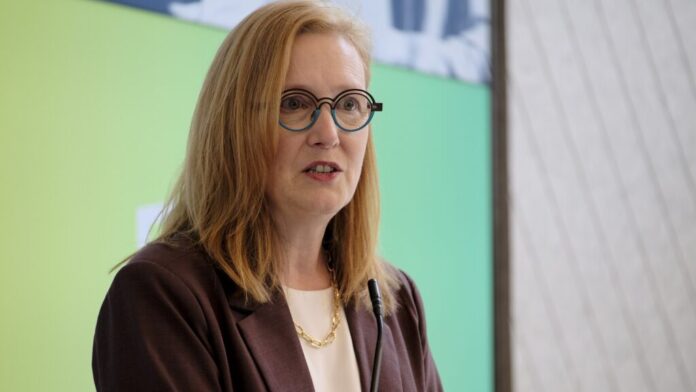
Finance Minister Brenda Bailey tabled the budget update Thursday.
It projects B.C.’s economy to grow by 1.4 per cent this year — down slightly from the 1.5 per cent growth forecast in last quarter’s update — as U.S. tariffs and global uncertainty hit exports and business investment.
“We’re undoubtedly seeing the impact of U.S. tariffs,” Bailey said. “We’re diversifying our trade relationships with new partners and approving major industrial projects to provide good jobs for people and economic security, no matter what the world throws at us.”
The report said increased revenues largely stem from personal and corporate income tax, though a significant amount of those gains are due to prior-year adjustments from updated 2024 assessments.
The report said retail sales have also been stronger than expected, partly due to a rush to purchase big-ticket items, such as vehicles, before U.S. tariffs kicked in. However, Bailey said retail sales are starting to slow and that downward trend is expected to continue.
Bailey also said the province is on track to exceed its target of reducing government expenditures by $300 million this year through cuts to administrative costs. She said the B.C. Public Service is expected to shed the equivalent of 700 full-time employees this fiscal year, after a hiring freeze implemented last December and job action by public sector workers.
Changes to the timing of projects mean taxpayer supported capital spending decreased by $763 million compared to the first quarter, to $13.9 billion. Bailey noted those costs will be shifted to future years.
Taxpayer supported debt was forecast at $117.7 billion for the year.
Bailey warned that while the numbers show some improvement from the last update, the province continues to face significant spending pressures.
“This snapshot shows that our deficit is slightly down, but the financial pressures that we face have not abated,” said Bailey. She said health care costs are rising with B.C.’s aging population, while federal immigration policies are impacting the labour force.
Bailey said it is too early to see the full impact of the recent strike by public service workers with the B.C. General Employees Union, but acknowledged the mediated agreement reached in late October would significantly affect the government’s bottom line in future years.
The BCGEU reached an mediated agreement with the province after two months of job action. It included a general wage increase of three per cent each year for four years.
Bailey said there were income losses due to BCGEU strike action that shut down B.C. Liquor Distribution Board warehouses and provincial liquor and cannabis stores for weeks. Bailey said any payroll savings during the strike likely won’t make up for the lost income from liquor sales.
The budget update also shows natural resource revenues are down $20 million, mainly due to lower water availability and falling oil prices.
Total wildfire spending for the fiscal year is expected to be $725 million, which was about $126 million lower than forecast in the first quarter.
The B.C. Wildfire Service said this year’s wildfire season saw close to 8,900 square kilometres burned, but was less destructive than the previous two seasons.
In its annual report on the fire season released earlier this month, the BCWS said $510 million had been spent on wildfire suppression as of Nov. 1.
That compares to $621 million by the end of the 2024 wildfire season, and about $1.1 billion in 2023.
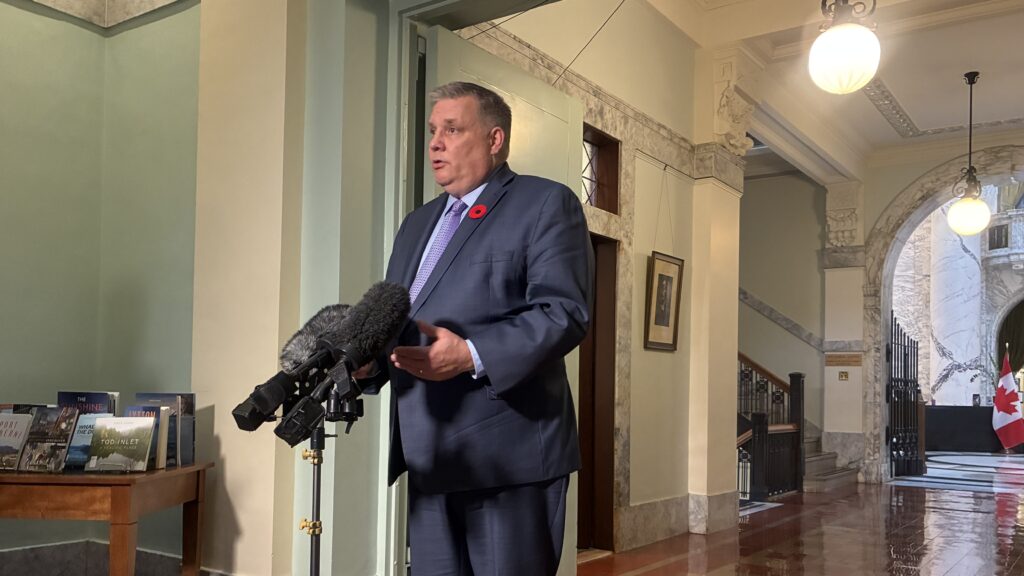
B.C. Conservative finance critic Peter Milobar said the budget report is “very concerning,” pointing to the province’s mounting deficit year-over-year and the budget’s reliance on prior-year income and corporate tax adjustments in its revenues.
The MLA for Kamloops Centre said the province is also using the “magical trick” of adding its share of the $2.7 billion tobacco settlement to its revenues for the year. B.C. received an initial payment of $936 million, but the rest of the funds are due to be paid out over the next 18 years.
When delivering the first quarterly update in September, Bailey denied accusations of using the settlement money to soften the appearance of B.C.’s sky-high deficit, insisting it was part of a normal accounting practice.
The post B.C. trims deficit to $11.2B but warns of ongoing financial pressures appeared first on AM 1150.