
About 5,000 workers at publicly-funded care homes in British Columbia will again be covered by the public collective agreement in the coming years.
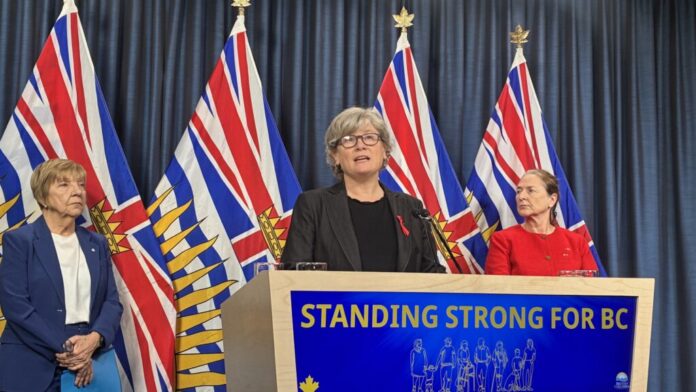
The province announced Monday an agreement between the Ministry of Health, the Health Employers Association of B.C. (HEABC) and the nine-union Facilities Bargaining Association (FBA).
It will bring eligible care-home operators to HEABC membership, so that workers can be covered by a collective agreement.
Voting to ratify the changes is taking place through Dec 20.
Health Minister Josie Osborne said the move will benefit workers who currently lack access to similar pensions and benefits as those doing the same type of work in hospitals.
“This is about returning to a consistent provincial framework that supports workers in a way that is fair across work sites, across job sites, and different long-term care operations,” she said.
Lynn Bueckert, Secretary Business Manager of the HEU, said publicly-funded care homes can offer widely different wages and working conditions, depending on who’s running the site.
“Today’s announcement marks a major step forward in repairing and rebuilding a seniors’ care system that has been deeply fractured by two decades of privatization,” said Bueckert.
The B.C. Liberals, under then-premier Gordon Campbell, introduced legislation in the early 2000s that allowed health authorities and care home operators to contract out care and support services to private companies.
The Hospital Employees Union says thousands of workers were fired in the ensuing years by care home operators who subcontracted staff and flipped those contracts to try to keep wages low and sidestep union collective agreements.
“This approach created a fragmented, low-wage sector with high turnover and a serious recruitment and retention crisis,” said Bueckert.
B.C. unions launched legal challenges, and in 2008, the B.C. government rescinded parts of the legislation that had been ruled unconstitutional by the Supreme Court of Canada. The province rescinded the legislation entirely in 2019.
Edil Bukid is a long-time care aide who now works at the Windermere Care Home in Vancouver. She said she lost out on about 20-years of growing her pension after her facility was taken over by private contractors who offered lower wages, fewer benefits and no pension.
“It was hard, not just for us, but for the seniors,” said Bukid. “There were new faces and lots of turn over.”
She said workers at her site have since returned to the Facilities Bargaining Association collective agreement, and she’s now rebuilding her pension.
The province said workers at about 100 publicly-run facilities would be transitioned into the agreement in two phases, starting next fall.
About half would return to the HEABC over the course of a year, starting in October 2026. All remaining eligible operators would be brought back into the agreement between Oct. 1 2027 and Sept 30. 2028.
Osborne said the transition is expected to cost the province $85 million.
She said wage-levelling payments for the HEABC-eligible sites will continue until at least the end of March 2027.
B.C introduced wage-levelling in early 2020 as part of its response to the COVID-19 pandemic. The policy brought wages at both publicly funded and fully private long-term care homes in line with public sector agreements.
The province informed operators and unions this past summer it would end wage-levelling for fully private long-term care and assisted living sites at the end of this year. The Hospital Employees Union (HEU) said workers at the sites could face significant wage cuts if employers refused to make up the difference.
Osborne said operators that have fewer than half of their beds publicly-funded are not included in the agreement. She acknowledged there’s still more work to do.
The post B.C. moves to bring 5,000 care-home workers back under public agreement appeared first on AM 1150.