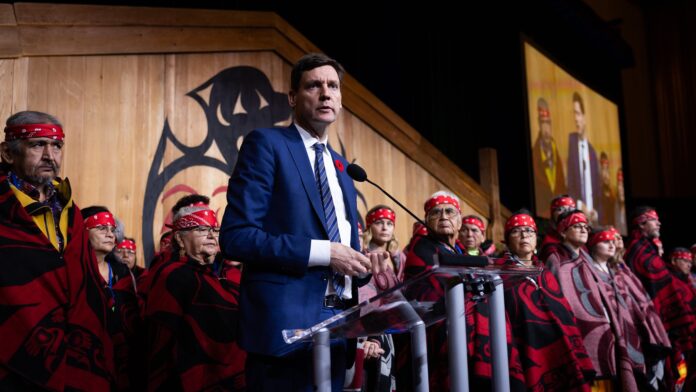

Premier David Eby and Coastal First Nations are calling on the federal government to uphold the oil tanker moratorium in British Columbia’s northern waters.
A joint declaration to protect B.C.’s north coast was signed Wednesday by Eby, Coastal First Nations president and Heiltsuk First Nation Chief Marilyn Slett, Lax Kw’alaams Mayor Garry Reece, Haida Nation president Jason Alsop, hereditary elder Clarence Innus and Paula Amos with Indigenous Tourism B.C.
The declaration said thousands of livelihoods are sustained by fisheries, tourism, renewable energy and stewardship along the north coast, generating nearly $2 billion for the economy.
“Repealing the tanker ban would risk near-term major projects and cheat B.C.’s economy out of thousands of jobs and billions of dollars in investments. Over the long term, the consequence of a crude-oil spill in these waters would be generations of lost livelihoods and irreversible ecological damage,” said the joint statement.
The declaration was released during the two-day B.C. Cabinet and First Nations Leaders’ Gathering in Vancouver, which included more than 1,300 one-to-one meetings between provincial officials and First Nations leaders.
The federal government formalized the moratorium in 2019, prohibiting oil tankers carrying more than 12,500 metric tonnes of oil. It covers the area from the Alaska border, down to the point on British Columbia’s mainland across from the northern tip of Vancouver Island, including Haida Gwaii.
A voluntary tanker exclusion zone had been in place in the region since 1985.
Alberta Premier Danielle Smith has long been calling on Ottawa to repeal the ban. Smith wants a pipeline carrying Alberta bitumen to the Port of Prince Rupert on B.C.’s north coast, and has said the oil tanker ban is one of several road blocks to that plan.
Smith said last month her government would submit a formal application to the federal Major Projects Office (MPO) to fast-track a new pipeline project, supported by $14 million from her government. The advisory group for the application includes energy companies South Bow, Enbridge and Trans Mountain. Alberta expects to submit the application to the MPO by next spring.
Eby has repeatedly dismissed the pipeline proposal, noting there is no private backing for the project. He has called it a threat to the many shovel-ready projects in B.C.
Dozens of major energy companies have also called on Ottawa to repeal the ban. It was among a number of recommendations in a joint letter by industry stakeholders to Prime Minister Mark Carney in September.
Speaking last month, Carney said he is open to the idea of a new pipeline to the west coast, if the project would be of economic benefit to Canada, is consistent with climate goals, and has opportunities for Indigenous participation. He also did not rule out repealing the tanker ban.
B.C. Conservative Leader John Rustad said Wednesday Eby is opposing the tanker ban for ideological reasons.
“Rather than advancing nation-building energy projects to diversify markets, create thousands of skilled jobs, and deliver prosperity for our province, the NDP continue to discourage investment,” said Rustad in a statement.